

Design a 75 Gallon Reef Tank: Complete Setup Guide
Table of Contents
- Planning Your 75 Gallon Reef Tank Foundation
- 75 Gallon Reef Tank Equipment List: What You Actually Need
- Building Your Sump and Plumbing Setup
- Water Chemistry Fundamentals and Cycling
- Best Stocking Ideas for 75 Gallon Reef
- Aquascaping and Live Rock Placement
- 75 Gallon Reef Tank Maintenance Schedule
- Smart Monitoring and Automation for Long-Term Success
- Frequently Asked Questions
Last Updated: September 19, 2026
Planning Your 75 Gallon Reef Tank Foundation
A 75 gallon reef tank balances stable water parameters with residential space constraints, letting you experiment with mixed reef setups combining soft corals, LPS, and some SPS species without the complexity of larger systems.
A 75 gallon reef tank requires three core systems: the display tank, filtration and circulation, and stable water chemistry. Failure in any one cascades through the entire system.
Foundation decisions, tank dimensions, stand durability, plumbing layout, and electrical infrastructure, are nearly impossible to change later without complete teardown.
75 Gallon Reef Tank Equipment List: What You Actually Need
Setting up a 75 gallon reef tank requires filtration, circulation, lighting, and heating. Avoid buying the cheapest components; you'll upgrade within months when they underperform.
Tank and Stand Selection
A quality glass aquarium with proper bracing lasts 20+ years; a flimsy stand flexing under 600+ pounds of water and rock will eventually fail.
Standard rectangular tanks (48" × 18" × 20") fit most stands and equipment designed for this size class.
The Red Sea REEFER Deluxe 350 G3 (72 gallons, $3,800) includes dual ReefLED 115 lights and ReefMat-ready sump, eliminating guesswork on lighting and filtration layout. You're buying a complete engineered system rather than assembling mismatched components.

If you're building from scratch with separate components, ensure your stand is rated for at least 750 pounds and constructed from solid wood or steel with cross-bracing. Particle board or thin plywood flexes under load and creates stress points in the tank seams.
Filtration and Circulation Systems
A sump-based filtration setup removes waste before it becomes nitrate and phosphate, offering more control and flexibility than canister filters despite requiring more plumbing.
The IceCap 15 Reef Sump v2 (15" × 15" × 14") fits under most 75-gallon stands with separated intake, skimming, and return sections, preventing the return pump from sucking air bubbles from the skimmer, a common problem that degrades water quality.
The Octo Classic 110INT handles bioload from tanks up to 130 gallons, using a pinwheel pump that draws massive air while consuming only 9 watts. The gate valve adjusts between wet and dry skimming based on bioload.
The IceCap Gyre 2K Flow Pump creates cross-flow circulation that sweeps the entire tank bottom, suspending detritus for filter sock capture. Unlike traditional powerheads, its dual transverse flow cages produce a broad water sheet that prevents dead zones.
Lighting and Electrical Safety
Soft corals tolerate lower light; SPS corals demand high PAR. Most mixed reef setups run 150-250 PAR depending on coral placement.
The Red Sea ReefLED 115 lights deliver full-spectrum illumination with wireless ReefBeat App control for intensity and color spectrum adjustment, a feature costing hundreds extra if purchased separately.
Install a dedicated 20-amp circuit with GFCI outlet protection. Route all electrical cords through a drip loop (downward bend before the outlet) so water drips away from the outlet rather than into it.
Use a single surge-protected power strip rated for aquarium equipment, elevated to prevent water contact.
Building Your Sump and Plumbing Setup
A sump beneath the display tank handles filtration, skimming, and heating. Plumbing connects the display to the sump via overflow and returns filtered water back up.
Red Sea REEFER Deluxe 350 G3 Aquarium →
Size your drain line based on return pump flow. Most 75-gallon setups use a single 1-inch drain line (600-800 GPH); if your return is 750 GPH, your drain should handle at least that much.
The sump needs three sections: intake, filtration (skimmer and media), and return. The IceCap 15 uses built-in baffles to separate these zones.

Use PVC pipe for rigid runs and flexible vinyl tubing for equipment connections. Install ball valves on drain and return lines for maintenance shutdowns. Size bulkheads to match pipe diameter.
Adjust the skimmer gate valve until it produces a steady stream of dark skimate into the collection cup. Too wet wastes nutrients; too dry fails to remove organics efficiently.
Water Chemistry Fundamentals and Cycling
Before adding corals or fish, your tank must cycle (3-6 weeks) to establish beneficial bacteria that convert ammonia to nitrite, then nitrite to nitrate.
Use RO/DI water; tap water contains minerals, chlorine, and chloramines that harm corals and fish. The IceCap 100 GPD system removes 96-98% of dissolved solids, producing enough water for weekly 75-gallon changes.
Once you have clean water, mix it with marine salt to create saltwater at 1.025 specific gravity. Measure salinity with a refractometer, digital or optical, both work, and aim for consistency.
Best Stocking Ideas for 75 Gallon Reef
Aquascaping and Live Rock Placement
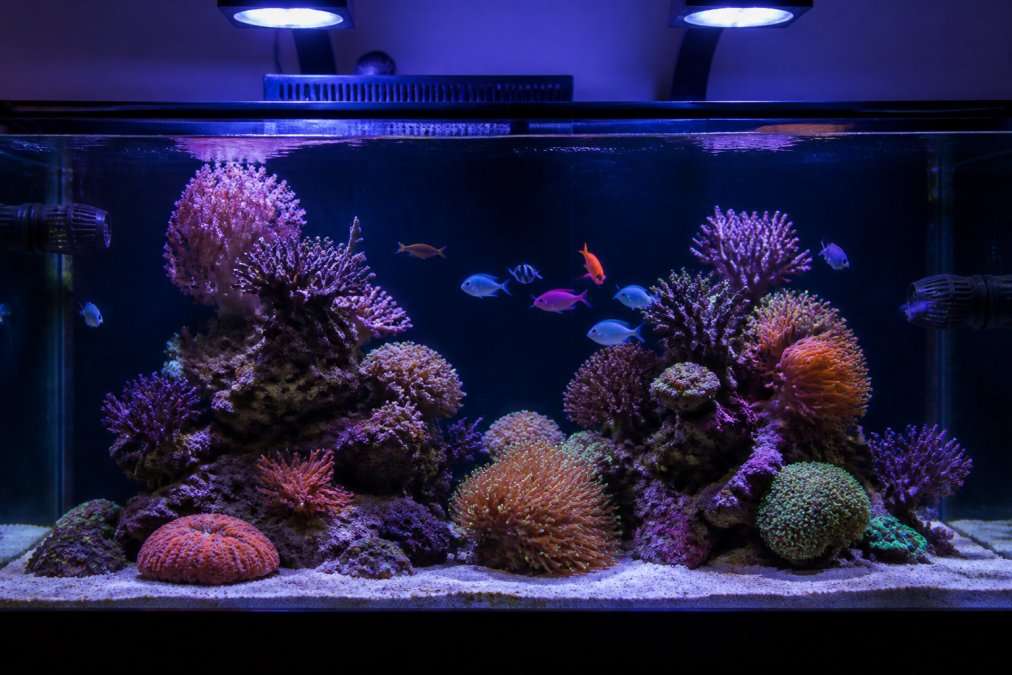
Live rock creates the foundation for corals and provides biological filtration through the bacteria colonies living in its porous structure. A 75-gallon tank typically needs 60-90 pounds of live rock depending on density.
75 Gallon Reef Tank Maintenance Schedule
Consistency keeps reef tanks healthy. Establish a routine and stick to it.
| Task | Frequency | Duration | Notes |
|---|---|---|---|
| Water change | Weekly | 20-30 min | 20-25% of tank volume |
| Parameter testing | 2x weekly | 10 min | Alkalinity, calcium, salinity, nitrate |
| Skimmer cleaning | Weekly | 5 min | Empty collection cup, rinse |
| Filter sock replacement | 2-3x weekly | 5 min | Replace when 50% full |
| Heater/pump inspection | Monthly | 5 min | Check for salt creep, noise changes |
| Deep cleaning | Quarterly | 1-2 hours | Clean powerheads, inspect plumbing |
Smart Monitoring and Automation for Long-Term Success
Modern reef keeping benefits from automation. Automated dosing systems maintain alkalinity, calcium, and magnesium. Automated feeders dispense food at consistent times. Smart monitoring systems alert you to parameter swings before they become crises.
Frequently Asked Questions
What are the standard dimensions of a 75 gallon tank?
A standard 75 gallon reef tank measures 48 inches long, 18 inches wide, and 20 inches tall. These dimensions are ideal for a 75 gallon reef tank because they provide good surface area for gas exchange and enough depth for both SPS and LPS corals. Verify exact dimensions with your tank manufacturer, as some reef-ready models may vary slightly depending on overflow box placement and internal baffles.
How many fish can I stock in a 75 gallon reef tank?
A 75 gallon reef tank typically supports 8-12 small fish or 4-6 medium-sized fish, depending on bioload and filtration strength. Stocking density matters less than water quality; a strong protein skimmer and sump system allow for higher bioload. Start conservatively and monitor nitrate and phosphate levels. Avoid overstocking during the first 6 months while your biofilter establishes.
What equipment is essential for a 75 gallon reef system?
Essential equipment includes a protein skimmer (like the Octo Classic 110INT), a return pump, a sump (such as the IceCap 15 Reef Sump V2), lighting with appropriate PAR levels, a flow pump for circulation, and an RO/DI water filtration system. You'll also need a heater, thermometer, refractometer for salinity, and test kits for alkalinity, calcium, and nitrate. Quality equipment from brands like Red Sea and IceCap ensures reliability.
How do I choose the right lighting for a 75 gallon reef tank?
Choose lighting based on your coral types. SPS corals need 200-400 PAR; LPS and soft corals need 75-150 PAR. LED systems like Red Sea ReefLED lights offer wireless control and full spectrum tuning. For a 75 gallon tank, two quality LED fixtures positioned 12-18 inches above the water surface work well. Avoid placing lights directly over sensitive corals; use mounting arms to adjust height and angle for even PAR distribution.
What's the difference between a reef-ready and standard 75 gallon tank?
A reef-ready 75 gallon tank includes pre-drilled overflow holes and internal baffles for a sump system, allowing water to drain passively into your filtration chamber. Standard tanks lack these features, requiring a hang-on overflow box instead. Reef-ready tanks cost more upfront but provide cleaner plumbing, quieter operation, and better water circulation. For serious reef keepers, a reef-ready setup justifies the investment.
How often should I perform water changes on a 75 gallon reef tank?
Perform 20-25% water changes every 2 weeks on a well-established 75 gallon reef tank. If you're running aggressive stocking or high-bioload fish, increase to weekly 25% changes. Use RO/DI water mixed with quality reef salt to maintain stable salinity and alkalinity. Monitor nitrate and phosphate after each change; if levels remain elevated, increase change frequency or improve your protein skimmer efficiency.
What corals are best for a beginner 75 gallon reef tank?
Start with hardy soft corals like leather corals and mushrooms, then add LPS corals such as torch corals and brain corals once your water chemistry stabilizes. These are forgiving and grow well in moderate lighting. After 3-6 months, introduce SPS corals if your alkalinity, calcium, and flow rates are dialed in. Blue Earth Corals offers healthy, aquacultured specimens that ship safely and arrive ready to acclimate.
Coral Acclimation Guide for Hobbyists: 2026 Edition
SPS vs LPS Coral Care Requirements
Related Posts

How to Choose the Right Coral Lighting

SPS vs LPS Coral Care Requirements

Coral Acclimation Guide for Hobbyists: 2026 Edition

Professional Reef Tank Installation Cost: 2026 Guide

How to Prevent Fish Disease Introduction: 7 Steps

Troubleshooting Common Reef Tank Problems: 2026 Guide
