

Professional Reef Tank Installation Cost: 2026 Guide
Table of Contents
- What Professional Reef Tank Installation Cost Covers
- Cost Per Gallon: Real Numbers by Tank Volume
- Best Equipment for Starting Saltwater Tanks
- Custom Aquarium Installation Services vs. DIY
- Reef Tank Maintenance Cost After Installation
- Used vs. New Equipment and Regional Labor Rates
- Frequently Asked Questions
Last Updated: September 15, 2026
What Professional Reef Tank Installation Cost Covers
Professional reef tank installation cost is the total of equipment, labor, and system design fees required to set up a functioning reef aquarium. At Blue Earth Corals and Aquariums, we've handled residential and commercial builds for over 19 years, and the biggest mistake we see is buyers budgeting only for the tank itself. Hardware is roughly half the story; the rest is plumbing, cabinetry, and specialist hours.
Most quotes break into four buckets: the tank and stand, the sump and filtration package, plumbing and electrical work, and labor.
Tank, Stand, and Custom Cabinetry
The tank, stand, and cabinet usually make up the largest single line item. Off-the-shelf reef-ready tanks cost less because the cabinet is mass-produced; custom cabinetry costs more because it's built to your room's dimensions and finish, and it changes the installation timeline.
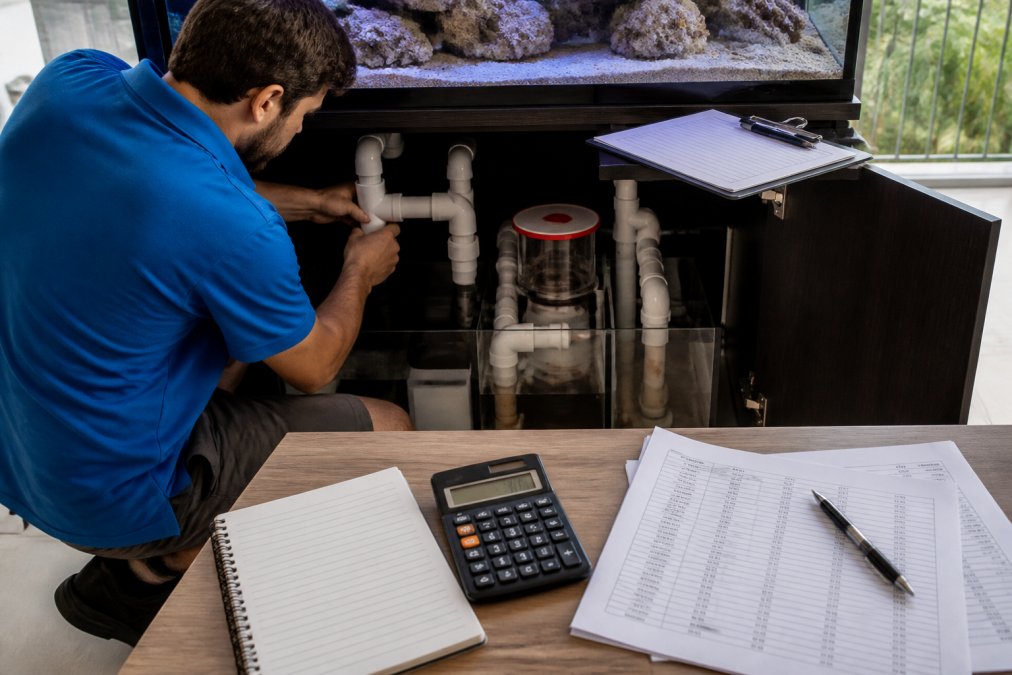
Plumbing, Sump, and Filtration Installation Fees
Plumbing and filtration labor is where DIY projects most often go wrong. A sump system needs correct drain sizing, return pump matching, and leak-tested joints before the tank ever sees water. Installation fees reflect the hours spent running lines, fitting bulkheads, and pressure-testing connections. A slow leak behind cabinetry can cost far more to fix than the original labor.
Cost Per Gallon: Real Numbers by Tank Volume
Cost per gallon is the quickest way to sanity-check a quote: the number drops as tank volume rises, because fixed labor and equipment costs spread across fewer gallons on small systems.
| Tank Volume | System Type | Relative Cost Per Gallon | Typical Setup Scope |
|---|---|---|---|
| 40-75 gallons | Reef-ready, off-the-shelf | Highest | Basic sump, single return |
| 90-120 gallons | All-in-one or custom | Moderate | Dual return, skimmer, dosing |
| 150-180 gallons | Custom, reef-ready | Lowest | Full sump room, automation |
How Tank Size and System Type Shift the Price
Tank size and system type shift the price more than any other variable. A 180-gallon custom build with a dedicated sump room and automated dosing runs a very different labor total than a 75-gallon all-in-one. Volume matters less than complexity.
Best Equipment for Starting Saltwater Tanks
The best equipment for starting saltwater tanks is a matched package: a reef-ready tank, a correctly sized protein skimmer, adequate lighting, and an RO/DI unit. Buying these as a set means the components are already sized to work together, removing the most common source of early failures.
Lighting, Skimmers, and RO/DI Units
Lighting fixtures drive a large share of hardware cost, and the choice depends on what you plan to keep: SPS corals demand more intense lighting than LPS or soft corals. A protein skimmer should be rated above your actual water volume (10 Different Skimmer in use at the Reef Builders Studio (Video) | Reef Builders). The RO/DI unit is non-negotiable, tap water introduces phosphates and silicates that fuel algae outbreaks from day one (the EPA).
Red Sea's REEFER MAX line, which we carry, bundles the tank, sump, and automation into one system. The Red Sea REEFER MAX S-550 G3 Aquarium System at 118 gallons is a strong mid-size entry point, while the Red Sea REEFER MAX 750 G3 at 158 gallons suits larger displays.


Custom Aquarium Installation Services vs. DIY
Custom aquarium installation services handle design, plumbing, and system commissioning as one package, while DIY splits those tasks across your own weekends. DIY saves labor dollars but costs time, and one plumbing error can undo the savings.
What a Professional Consultation Actually Includes
A professional consultation covers site assessment, load-bearing checks, electrical planning, and a system layout matched to your space, plus ongoing needs like top-off water access and ventilation. It's the step most DIY builders skip, and the one that prevents expensive rework.
Reef Tank Maintenance Cost After Installation
Reef tank maintenance cost is the recurring expense that decides whether a build stays healthy past month six. The useful version is a total cost of ownership model: monthly spend, what drives it up or down, and how a maintenance contract changes the math versus DIY.
What Actually Drives the Monthly Number
Four variables move a reef tank's monthly cost more than anything else:
- System volume. A 40-gallon AIO and a 180-gallon custom build do not scale linearly. Water change, dosing, and media costs rise with gallons, but labor rises faster because larger systems have more failure points.
- Livestock load and type. A soft-coral tank tolerates wider parameter swings than an SPS-dominated tank, which needs more frequent testing, tighter alkalinity and calcium control, and more dosing product.
- Automation level. A controller with dosing pumps, auto top-off, and a salinity probe reduces hands-on hours but adds consumables (probes, tubing, calibration fluid) and higher upfront hardware cost.
- Water source. An RO/DI unit with a healthy membrane and resin produces near-zero TDS water cheaply. A neglected unit drives TDS up, which drives algae, labor, and media use. Membrane and resin replacement is recurring, not one-time.
Energy Consumption and Utility Impact
Electricity is the most commonly overlooked recurring cost in a reef build: reef equipment runs 24/7, so wattage translates directly into kilowatt-hours and a monthly bill line.
The continuous draws on a typical reef system are:
- Return pump, runs continuously, sized to system volume and head height
- Protein skimmer pump, runs continuously
- Lighting, high-output LED fixtures on a photoperiod, typically 8-12 hours per day
- Heaters, cycle on and off; draw depends on room temperature and tank volume
- Chiller, only on larger or warm-room systems, but one of the highest intermittent draws
- Wave makers and dosing pumps, low draw, but continuous
To estimate your own number, add the running wattage of each device, multiply by hours per day, divide by 1,000 for daily kWh, then multiply by your utility's rate. A larger system with a chiller and multiple high-output fixtures can consume several times the electricity of a small AIO with a single LED bar, factor utility impact into the startup budget, not just equipment.
Professional Maintenance Contracts vs. DIY
The ROI of a professional maintenance contract is not just convenience, it is failure avoidance. A reef tank that crashes, from a missed top-off, a failed heater, a dosing overdose, or a power outage that stops circulation, costs the livestock, the time to re-cycle, and often partial equipment replacement.
A maintenance contract typically bundles:
- Scheduled water changes at a defined volume and frequency
- Parameter testing (alkalinity, calcium, magnesium, salinity, nitrate, phosphate)
- Dosing adjustments based on those test results
- Filter media and consumable replacement
- Equipment inspection, pumps, heaters, probes, plumbing joints
- Emergency response for outages, leaks, and livestock stress events
The break-even point between DIY and a contract is not the cost of supplies, it is the cost of a single significant failure. For a small soft-coral tank, DIY is often cheaper.
Used vs. New Equipment and Regional Labor Rates
What Is Safe to Buy Used, and What Is Not
Generally safe to buy used:
Buy new, not used:
How Regional Labor Rates Actually Vary
Three factors drive the spread:
How to Combine Both Levers
Frequently Asked Questions
How much does it cost to set up a reef tank with professional installation?
A complete professional reef tank installation typically runs from around $3,000 for a small plug-and-play system to well over $25,000 for a large custom build. The total depends on tank volume, cabinetry, sump and filtration design, lighting fixtures, and labor. All-in-one systems such as the Red Sea REEFER MAX S-550 G3 at $8,449 already include the sump, plumbing, and smart automation, which removes several line items from an installation quote.
What factors influence the price of custom aquarium installation?
Tank volume drives most of the cost, followed by custom cabinetry, the complexity of plumbing installation, and whether the tank sits on a main floor or needs structural reinforcement. Reef tank installation pricing also reflects access to the room, the number of electrical circuits required, and how much aquascaping and livestock placement you want handled on day one. A professional consultation usually identifies these variables before you commit to a startup budget.
Is professional reef tank installation worth the investment?
For tanks over roughly 75 gallons, professional installation usually pays for itself by avoiding equipment mismatches and plumbing leaks that damage floors. A properly designed filtration system and sump also reduce early livestock losses, which protects your livestock budget. Professional maintenance contracts add ongoing value because consistent water chemistry and dosing keep SPS corals and LPS corals stable, and hardware lasts longer when it is serviced on a regular maintenance schedule.
How much does ongoing maintenance cost after installation?
Reef tank maintenance cost after installation typically covers water changes, RO/DI unit filter replacement, automated dosing supplies, and periodic equipment servicing. Monthly operating expenses also include electricity for lighting fixtures, pumps, and heaters, plus salt mix and test kits. A professional maintenance contract bundles these tasks and often costs less per month than replacing livestock lost to unstable water chemistry.
How to Prevent Fish Disease Introduction: 7 Steps
Coral Acclimation Guide for Hobbyists: 2026 Edition
Related Posts

How to Choose the Right Coral Lighting

SPS vs LPS Coral Care Requirements

Design a 75 Gallon Reef Tank: Complete Setup Guide

Coral Acclimation Guide for Hobbyists: 2026 Edition

How to Prevent Fish Disease Introduction: 7 Steps

Troubleshooting Common Reef Tank Problems: 2026 Guide
