

What to Look for in Healthy Corals: 2026 Reef Guide
Table of Contents
- Visual Signs of Healthy Corals: What You Should See
- Why Is My Coral Losing Color? Common Causes and Fixes
- Signs of Coral Stress in Aquarium Systems
- How to Acclimate New Corals Without Triggering Stress
- Water Parameters That Keep Corals Thriving
- Hard vs. Soft Corals: Health Differences You Need to Know
- Your DIY Diagnostic Checklist for Coral Health
- Why Biodiversity and Reef Monitoring Matter in Your Tank
- Frequently Asked Questions
Last Updated: September 12, 2026
Visual Signs of Healthy Corals: What You Should See
A healthy coral shows full polyp extension, even coloration, and clean tissue with no exposed skeleton. At Blue Earth Corals and Aquariums, we've spent 19 years helping hobbyists understand these signals. According to NOAA's coral reef monitoring guidance, visual assessment remains the first line of reef health evaluation, both in the wild and in captivity. Below, we'll walk through exactly what to look for in healthy corals, from polyp behavior to water chemistry, so you can spot a problem before it costs you a colony.
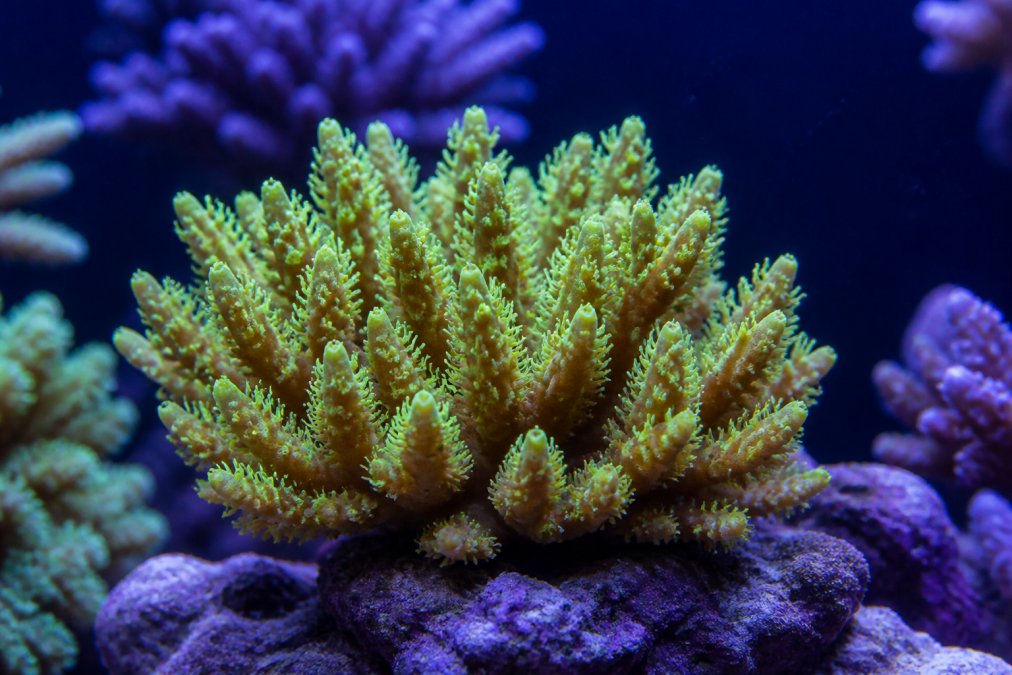
Polyp Extension and Tissue Integrity
Polyp extension is the single most honest health signal a coral gives you. Fully extended polyps mean the coral is actively feeding, respiring, and maintaining its symbiotic algae relationship. Polyps retracted for more than a day or two mean something in the environment has changed. Check tissue integrity next: healthy tissue sits flush against the skeleton with no gaps, no stringy tissue sloughing, and no white bands creeping outward.
Coloration and Pigmentation Patterns
Even pigmentation across a colony signals a coral holding its zooxanthellae population steady. Patchy color, pale tips, or a washed-out base are early warnings. Some color shift is normal after shipping or a lighting change; the difference between stress and adaptation is timing. Color that fades over weeks and stabilizes is fine. Color that drops in days is not.
Why Is My Coral Losing Color? Common Causes and Fixes
Color loss almost always traces back to one of four causes: lighting mismatch, temperature swings, nutrient imbalance, or environmental stress from a recent move. It usually means the coral is expelling zooxanthellae, the algae that give it pigment and most of its energy.
| Symptom | Likely Cause | First Fix |
|---|---|---|
| Pale but extended polyps | Lighting too intense | Lower coral, reduce photoperiod |
| Brown, dull color | Excess nutrients | Check phosphate and nitrate |
| White patches spreading | Tissue necrosis | Isolate, test alkalinity |
| Color loss within days of arrival | Acclimation shock | Dim lights, reduce flow |
Zooxanthellae and the Role of Symbiotic Algae
Zooxanthellae are microscopic algae living inside coral tissue that supply energy through photosynthesis. When temperature stability breaks down or nutrient levels swing, the coral expels them and the white skeleton shows through, that's bleaching. In an aquarium, bleaching is reversible if you correct the cause quickly. Left alone for a week, partial mortality sets in and that section won't recover.
Signs of Coral Stress in Aquarium Systems
Stress in a reef tank rarely appears overnight. It builds through small deviations in salinity, alkalinity, or flow, and the coral shows it before your test kit does. Watch for retracted polyps during peak lighting, a sudden stop in calcification, or algal growth creeping onto coral tissue. Algae growing on a coral means the tissue underneath is already dying.
Tissue Necrosis and Skeletal Exposure
Tissue necrosis is the point of no return for affected areas: bare white skeleton, sometimes with a sharp line between living tissue and dead structure. This is skeletal exposure, and it spreads. Waiting to see if it stops on its own usually fails. Frag the healthy portion away from the dead zone and dip it before necrosis reaches the whole colony structure.
How to Acclimate New Corals Without Triggering Stress
Acclimation is where most coral losses actually happen, not in shipping. Match temperature, salinity, and light intensity gradually so the coral never experiences a shock. Here's the process we recommend:
- Float the bag for 15-20 minutes to equalize temperature
- Drip-acclimate for 45-60 minutes, matching tank salinity
- Dip the coral per your dip manufacturer's instructions
- Place it low in the tank, in moderate flow, for the first week
- Move it to its final position over 2-3 weeks, raising light slowly
- Feed lightly after the first 48 hours, once polyps extend
Expected result: polyps extending within 24-72 hours. If they don't, dim the lights and reduce flow before assuming the coral is lost. Pairing proper acclimation with a stable water parameters routine from day one prevents most of these problems.
Water Parameters That Keep Corals Thriving
Stability beats perfect numbers every time. A coral tolerates slightly off parameters far better than swinging ones. Test alkalinity, calcium levels, magnesium, salinity, and temperature consistently, and log results so you spot trends rather than reacting to single readings.
Here are the ranges most reef keepers target for a mixed reef, along with what each one actually does inside the coral:
| Parameter | Common Target Range | What It Does | Swing Tolerance |
|---|---|---|---|
| Temperature | 76-79°F | Drives metabolism and zooxanthellae function | Under 1°F per day |
| Salinity | 1.024-1.026 SG (about 35 ppt) | Sets osmotic balance for every cell | Under 0.001 SG per day |
| Alkalinity | 7-9 dKH | Supplies carbonate for calcification | Under 0.5 dKH per day |
| Calcium | 400-450 ppm | Building block of the aragonite skeleton | Under 20 ppm per day |
| Magnesium | 1250-1350 ppm | Keeps calcium and carbonate in solution | Under 50 ppm per day |
| Phosphate | 0.03-0.10 ppm | Coral energy and color; too low starves, too high browns | Slow drift only |
| Nitrate | 2-10 ppm | Feeds zooxanthellae and tissue growth | Slow drift only |
Why alkalinity matters most: Alkalinity buffers pH and supplies the carbonate hard corals withdraw to build skeleton. When it drops fast, calcification stalls before any visible symptom appears, which is why a daily alkalinity reading tells you more about hard coral health than any other single test.
Why magnesium is the quiet one: Magnesium keeps calcium and carbonate from precipitating out of solution. Below roughly 1200 ppm, you can chase calcium and alkalinity all day and never hit your numbers, because the two bind together and drop out of the water column instead of staying available to the coral.
For magnesium testing specifically, the Hanna Instruments HI783 [Marine Magnesium Colorimeter(/products/marine-magnesium-colorimeter-hi783) | hannainst.com] gives hobbyists a precise reading without guesswork, and we carry it because accurate magnesium numbers keep calcium and carbonate available for calcification. Maintaining temperature stability and topping off evaporation with fresh water, not saltwater, keeps salinity steady. An auto top-off system removes the daily guesswork entirely; a gravity-fed unit works well for nano setups, while a powered unit suits larger systems.
The stability rule in practice: If a reading is inside range but moving fast, correct the trend, not the number. If it's slightly outside range but flat, watch and adjust slowly. A coral that sees 8 dKH daily for a month is healthier than one bouncing between 7 and 10.
Hard vs. Soft Corals: Health Differences You Need to Know
Hard corals build a calcium carbonate skeleton, and their health shows in calcification rate and tissue coverage over that skeleton. Soft corals lack a rigid skeleton, so their health shows in colony size, polyp extension, and tissue firmness. But "healthy" looks different for every species, a thriving coral can look pale, brown, fuzzy, or smooth. Here's how to read the baseline for the major groups hobbyists keep.
Stony Corals (SPS)
Small polyp stony corals like Acropora, Montipora, and Stylophora show health through calcification at the tips and edges. A healthy Acropora has visible axial corallites with polyps extending and a lighter rim of new skeleton at every growing point. Baseline color varies by species and lighting: high-light Acropora can be pastel, while the same species under lower light is deeper and browner, that's zooxanthellae density responding to light, not stress. The real warning signs are stalled tip growth, recession from the base upward, and a dull, uniform brown appearing over days rather than weeks.
Large Polyp Stony Corals (LPS)
Euphyllia (hammer, torch, frogspawn), Favia, and Trachyphyllia show health through tissue inflation and tentacle extension. A healthy torch inflates its tentacles by day and extends sweepers at night; a healthy Trachyphyllia puffs its fleshy tissue over the skeleton edge. LPS color is usually richer and more saturated than SPS, and a healthy Favia can look almost matte. Warning signs: deflated tissue that stays shrunken through the light cycle, exposed skeleton at the margins, and brown jelly-like discharge, a fast-moving infection rather than simple stress.
Soft Corals
Zoanthus, Sarcophyton (toadstool), Sinularia, and Xenia show health through polyp opening, stalk firmness, and expansion. A healthy toadstool opens its polyps into a fuzzy carpet and holds its cap upright; a healthy Xenia pulses. Soft coral color is the least diagnostic of all, since many species brown out or color up with nutrient levels without any health change. Warning signs: a closed polyp field for more than a day, a floppy or melting stalk, and tissue sloughing off in strings.
Why This Matters for Your Tank
The same water condition affects these groups differently. Soft corals tolerate wider parameter swings and higher nutrient levels; hard corals, especially SPS, are far less forgiving and show tissue necrosis or stalled growth long before a soft coral reacts. A single tank reading can be fine for one coral and a problem for another, and a single "healthy color" standard will mislead you on both. Learn the baseline for each species you keep, photograph it when thriving, and compare against that photo, not a generic image of a healthy reef.
Your DIY Diagnostic Checklist for Coral Health
Run through this checklist weekly. It takes five minutes and catches problems while they're still reversible.
- Polyps fully extended during peak lighting hours
- No white patches, bands, or exposed skeleton
- Coloration even across the colony, no pale tips
- No algae growing directly on coral tissue
- Alkalinity, calcium, and magnesium within your target range
- Salinity steady, checked with a calibrated refractometer
- Temperature stable, no swings over 2 degrees
- New growth visible at colony edges or tips
- No tissue sloughing or stringy discharge
- Feeding response within minutes of target feeding
Recovery signs to watch for: new polyp extension at the edges of previously damaged areas, a return of color over 2-3 weeks, and fresh skeletal growth at the tips. Those three signals tell you the coral has turned the corner.
Why Biodiversity and Reef Monitoring Matter in Your Tank
Biodiversity is a reef health metric most hobbyists overlook. A tank with diverse benthic cover, a healthy cleanup crew, and varied coral species handles nutrient swings better than a single-species setup. According to the EPA's coral reef conservation program, reef ecosystems rely on this diversity to buffer against stress, and the same principle scales down to your aquarium. Reef monitoring isn't just for scientists; logging your own tank's trends is the same practice at a smaller scale. A tank that mimics natural marine ecosystem balance, with proper colony structure and varied species, stays healthier with less intervention.
Keeping corals healthy comes down to reading the signals early and keeping your system stable, exactly where most hobbyists get stuck. Blue Earth Corals and Aquariums has spent 19 years helping reef keepers at every level, from a standard 75-gallon tank to full custom installations, with healthy livestock, Red Sea Coral Pro Salt for SPS-dominant and mixed reefs, and gear like the Marine Magnesium Colorimeter HI783 that takes the guesswork out of testing. Get started with Blue Earth Corals and Aquariums and build a reef system that thrives.

Frequently Asked Questions
How can you tell if a coral is healthy?
Look for full polyp extension, consistent coloration, and firm tissue with no white patches or exposed skeleton. Healthy corals show active feeding behavior and maintain their shape without tissue recession. Check for vibrant pigmentation and steady growth at the colony edges. In a reef tank, a healthy coral also responds to feeding within minutes and shows no signs of tissue sloughing or algal overgrowth on its surface.
What are the signs of a dying coral?
Key warning signs include tissue necrosis, where flesh peels away to expose white skeleton, and rapid color loss that leaves the coral pale or bleached. Partial mortality shows as dead patches spreading across the colony. You may also notice a foul smell, brown jelly-like substance, or algae colonizing bare skeleton. If polyp extension stops entirely and the coral does not respond to food, decline is likely advanced.
Should I buy corals with white patches?
Not always. Small white tips on growing SPS corals are normal new growth and a sign of calcification. However, white patches that look like exposed skeleton, especially with jagged edges or tissue peeling, indicate damage or disease. Ask the seller whether the white areas are growth tips or tissue loss. When in doubt, skip it. A coral with active tissue necrosis can crash your tank parameters and spread infection to other colonies.
How long should I quarantine new corals?
Most reef keepers quarantine new corals for 30 to 76 days to prevent introducing pests like flatworms, red bugs, and Aiptasia. During quarantine, observe for signs of stress such as color loss, tissue recession, or unusual mucus production. Dip corals according to product instructions before placing them in the quarantine tank. This period also gives you time to acclimate the coral to your lighting and water parameters gradually.
Professional Aquarium Cleaning Services West Palm
Troubleshooting Common Reef Tank Problems: 2026 Guide
Related Posts

How to Choose the Right Coral Lighting

SPS vs LPS Coral Care Requirements

Design a 75 Gallon Reef Tank: Complete Setup Guide

Coral Acclimation Guide for Hobbyists: 2026 Edition

Professional Reef Tank Installation Cost: 2026 Guide

How to Prevent Fish Disease Introduction: 7 Steps
