

Troubleshooting Common Reef Tank Problems: 2026 Guide
Table of Contents
- Your Diagnostic Flowchart for Reef Tank Problems
- Reef Tank Water Chemistry Parameters: The Ranges That Actually Matter
- Algae Blooms and Cyanobacteria: Identification and Removal
- How to Fix High Nitrates in Reef Tank Systems
- Corals That Won't Open: Stress, Pests, and Acclimation Errors
- Equipment Failures That Crash Reef Tanks (And How to Catch Them Early)
- Best Reef Tank Supplements for Growth: What to Dose and What to Skip
- Your Long-Term Maintenance Schedule and Monitoring Setup
- Frequently Asked Questions
Last Updated: September 13, 2026
Your Diagnostic Flowchart for Reef Tank Problems
Most reef keepers panic when something looks wrong, and that panic leads to the wrong fix. Troubleshooting common reef tank problems works better in a fixed sequence: salinity, temperature, alkalinity, nutrients, then light and flow. Salinity and temperature skew every other reading.
This guide from Blue Earth Corals and Aquariums walks that sequence, from water chemistry to equipment failures.
Here's the flow we use:
- Salinity and temperature - confirm both before trusting any other test
- Alkalinity, calcium, magnesium - the big three that drive coral stress
- Nitrate and phosphate - the nutrient side of algae and stalled growth
- Light, flow, and pests - the physical causes people overlook
- Equipment check - heaters, pumps, and top-off systems fail quietly
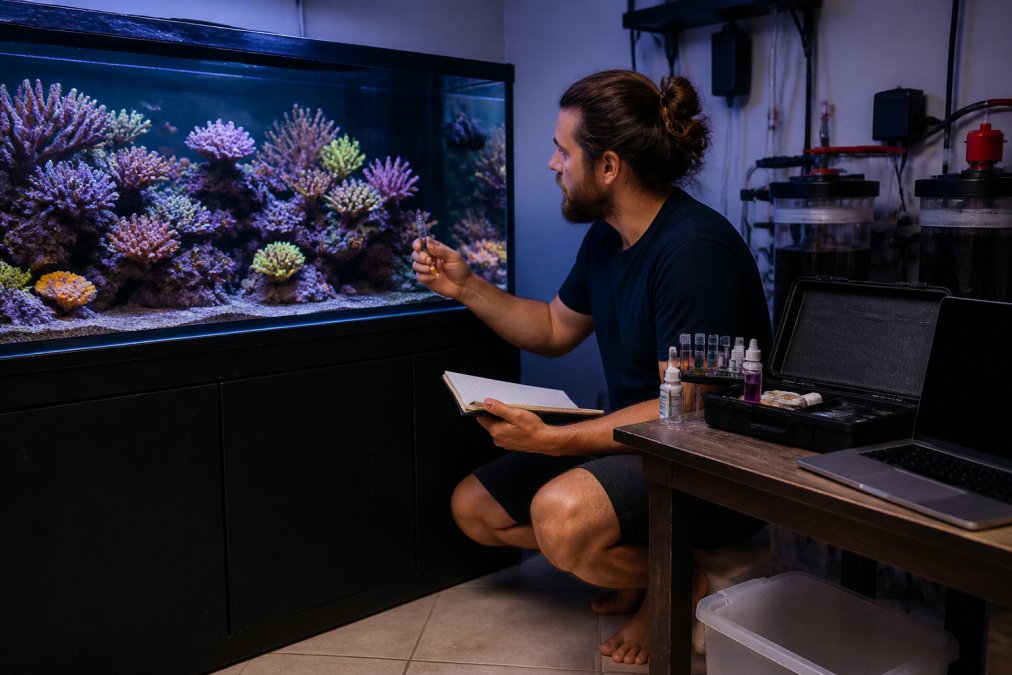
A common mistake is chasing one bad number instead of overall stability. Stability beats a perfect single reading every time.
Reef Tank Water Chemistry Parameters: The Ranges That Actually Matter
Reef tank water chemistry parameters are the foundation of every other diagnosis. If salinity is off, your calcium and alkalinity numbers are meaningless.
Alkalinity, Calcium, and Magnesium: The Big Three
Alkalinity is the water's capacity to resist pH change and the parameter most likely to drift in a stocked reef. Magnesium gets ignored, yet low magnesium makes it nearly impossible to hold calcium and alkalinity steady no matter how much you dose.
Test all three weekly on a young tank and twice weekly once coral growth picks up.
Salinity, Evaporation, and Top-Off Systems
Evaporation raises salinity because salt stays behind while water leaves; in a small tank, a day of evaporation can stress coral. An automatic top-off system replaces evaporated water continuously instead of in one big pour.
The IceCap ATO EZ handles this for most setups, and the IceCap Gravity ATO is a solid non-electric option for nano tanks. You can find both at IceCap ATO EZ.

Algae Blooms and Cyanobacteria: Identification and Removal
Algae blooms are a symptom, not the disease. Before buying a treatment, identify the organism: the fix for cyanobacteria does nothing for dinoflagellates.
Dinoflagellates vs. Cyanobacteria: Telling Them Apart
Cyanobacteria forms a slick, sheet-like mat that peels off rock in ribbons and often smells foul. Dinoflagellates look stringy and snotty, with bubbles trapped in the strands, and vanish at night, returning when lights come on.
That night-and-day behavior is the fastest field test you have. If it disappears overnight, suspect dinoflagellates.
How to Fix High Nitrates in Reef Tank Systems
High nitrates come from two places: too much going in, or not enough coming out. Overfeeding and heavy biological load push nitrate up; weak nutrient export lets it accumulate.
Nutrient Export: Water Changes, Siphoning, and Protein Skimmers
A protein skimmer removes dissolved organic waste before it becomes nitrate. Siphoning the substrate during water changes pulls out trapped debris a skimmer can't reach. Water changes handle the rest.
If nitrate keeps climbing despite all three, the problem is usually input, not export. Cut feeding before adding equipment.
A reliable source water supply matters too. The IceCap 100 GPD Reverse Osmosis RO/DI Water Filtration System gives you 0 TDS water so you aren't adding phosphate and nitrate with every top-off.

| Problem | Likely Cause | First Fix |
|---|---|---|
| Rising nitrate | Overfeeding, heavy load | Cut feeding, siphon debris |
| Rising phosphate | Source water, food | Test RO/DI output, use colorimeter |
| Salinity creep | Evaporation | Install auto top-off |
| Stalled coral growth | Low magnesium | Test and dose magnesium |
| Algae bloom returning | Unstable nutrients | Stabilize before treating |
Corals That Won't Open: Stress, Pests, and Acclimation Errors
A closed coral is telling you something, but "something is wrong" is not a diagnosis. Work through causes by likelihood and reversibility: parameter swing, pest, acclimation error, physical damage. Most cases resolve at step one.
Step 1: Check What Changed in the Last 72 Hours
Coral stress almost always traces to a recent event. Check your log for:
- An alkalinity swing greater than 0.5 dKH in a single day
- A salinity change greater than 0.001 specific gravity
- A temperature excursion above 82°F or below 76°F (noaa.gov)
- A new addition (fish, coral, or rock) that could have shifted bioload
- A dosing change, water change, or equipment swap
If you find a swing, correct it slowly, no more than 0.5 dKH per day for alkalinity, 0.001 SG per day for salinity. Chasing a fast fix turns a stressed coral into a dead one.
Step 2: Rule Out Pests
If parameters are stable, look for pests. The usual suspects in reef tanks are:
- Acropora-eating flatworms, small, tan, leaf-shaped, often clustered near the base or in shaded crevices. Dip and inspect at night when they are most active.
- Red bugs (Tegastes acroporanus), tiny yellow specks on smooth-skinned Acropora. Look with a magnifier; they are barely visible to the naked eye.
- Montipora-eating nudibranchs, white, fuzzy, and matched to the coral's color. Check the underside of plating colonies.
- Aiptasia and majano anemones, sting adjacent tissue and cause localized recession.
- Vermetid snails, cast mucus webs that irritate nearby polyps.
A 5- to 10-minute dip in a coral dip solution before any new coral enters the display is the single most effective preventive step. Dip every new coral, every time, even from a trusted source.
Step 3: Reassess Acclimation
Acclimation errors are the most preventable cause of closed corals. Temperature and salinity matter most, and need different handling:
- Temperature, float the bag for 15 to 20 minutes to equalize temperature first.
- Salinity and pH, drip acclimate over 45 to 60 minutes, matching the bag water to tank water slowly. A drip rate of 2 to 4 drops per second is a reasonable target for most setups.
- Light, place new corals low in the tank and move them up over 1 to 2 weeks. Light shock is the most under-diagnosed cause of a coral that opens in the bag and stays closed in the display.
Skipping the drip step can shock a coral that was healthy in the bag; skipping the light step does the same over a slower timeline.
Step 4: Look for Physical Damage and Flow Issues
If the first three steps clear, check for direct flow blasting the coral, a stinging neighbor (LPS sweeper tentacles reach several inches), or a fish nipping polyps. A coral that opens at night but stays closed by day is often picked on by a daytime-active fish.
Most closed-coral cases trace back to something that changed in the last 72 hours. Check your logs before you check your equipment, and correct any swing slowly rather than chasing a fast fix.
Equipment Failures That Crash Reef Tanks (And How to Catch Them Early)
Equipment failure is the quiet killer in this hobby. Most writing on reef tank problems focuses on biology, algae, nutrients, pests, and skips the hardware layer. That is a mistake: a failed heater, seized return pump, or cracked ATO line can wipe out a tank faster than any nutrient spike. Here is how to catch each failure point early.
Heaters and Temperature Control
A stuck heater is the classic tank-killer: the thermostat welds closed, the heater keeps running, and the tank climbs past 84°F before you notice. The fix is redundancy, a dedicated heater controller with its own probe cuts power when the primary thermostat fails.
A common pattern is to run two smaller heaters instead of one large one. If one sticks on, the other cannot push the tank into lethal range on its own. Size each heater to roughly half the total wattage you need for the tank volume.
Check the controller's probe placement monthly. A probe sitting in a dead-flow corner reads the wrong temperature and defeats the whole system.
Return Pumps and Powerheads
Flow loss is easy to miss because it happens gradually as impellers foul with calcium carbonate and biofilm. A pump that has lost half its output still looks like it is running. Check flow by hand weekly, not by eye, compare the feel at a return nozzle to last week.
Signs a pump is failing:
- Audible rattle or hum that was not there before
- Visible calcium deposits on the impeller or magnet
- Reduced flow even after a vinegar soak
- Intermittent stopping, which usually means the impeller magnet is swelling
Soak impellers in a 1:1 white vinegar and water solution for a few hours every 2 to 3 months (the EPA). Do not use harsh acids on magnets; they can degrade the coating and cause the impeller to seize.
Auto Top-Off (ATO) Systems
An ATO failure runs in two directions. A stuck-on ATO dumps fresh water continuously and crashes salinity; a stuck-off ATO lets salinity climb as evaporation continues. The stuck-on failure is more dangerous, dropping salinity by several points in a day.
Install a secondary float valve or a high-level sensor as a backup. Test the ATO weekly by lifting the sensor and confirming the pump shuts off. If your ATO reservoir holds more than a few days of top-off water, a stuck-on failure has more time to do damage, size the reservoir to roughly 3 to 5 days of evaporation, not a week or more.
Lighting
LED fixtures fail in slow, hard-to-notice ways: diodes dim or die, spectrum shifts as emitters age, and par output drops over years. A coral thriving under a fixture two years ago may be starving for light today.
If corals are stretching toward the light, losing color, or growing slowly despite stable parameters, borrow or rent a par meter and measure output at the coral's position. Compare against the fixture's original rating. Most LED manufacturers publish par charts at common mounting heights.
Plumbing, Seals, and the Slow Leak
Slow leaks do the most property damage. Check bulkheads, unions, and return line connections monthly for salt creep, dried salt residue means water is escaping somewhere. A small drip under a stand can go unnoticed for weeks.
Place a leak detector or a simple water alarm under the stand. They cost little and catch the failure before it warps a floor.
Do not rely on a single heater, a single return pump, or a single ATO sensor. Redundancy is the difference between a bad day and a tank crash. Every critical system should have a backup or a fail-safe.
Set a phone reminder to feel your return flow by hand once a week and to test your ATO shutoff once a week. A pump that has lost half its output still looks like it is running, and a stuck ATO sensor looks identical to a working one until the salinity drops.
Best Reef Tank Supplements for Growth: What to Dose and What to Skip
The best reef tank supplements for growth correct a measured deficiency, not a promise of faster color. Alkalinity, calcium, and magnesium are the core three; most everything else is optional.
Skip supplements you can't test for. If you can't measure it, you can't dose it safely, and blind dosing is how tanks get into trouble. When in doubt, dose less and test more.
Phosphate deserves its own test kit because it drives both algae and stalled calcification. The Phosphate Ultra Low Range PPM Colorimeter HI774 Hanna Checker reads low enough to catch problems before they show up on the glass.

Your Long-Term Maintenance Schedule and Monitoring Setup
Long-term reef health comes down to routine, not rescue. Consistent small maintenance rarely needs emergency intervention.
- Daily: check temperature, top-off reservoir, and livestock behavior
- Weekly: test alkalinity, calcium, magnesium, nitrate, phosphate
- Weekly: siphon visible debris and clean skimmer cup
- Biweekly: water change and salinity verification
- Monthly: inspect pumps, heater controller, and plumbing for wear
- Quarterly: replace filter media and check RO/DI output TDS
Digital monitoring takes the guesswork out of daily checks. A controller logging temperature and pH gives you a history to compare against, turning "something looks off" into a specific answer.
For keepers who would rather not manage all of this alone, our team at Blue Earth Corals and Aquariums offers professional maintenance for both residential and commercial tanks, backed by 19+ years of experience and an aquaculture facility in West Palm Beach.
Frequently Asked Questions
What are the signs of low magnesium in a reef tank?
Low magnesium shows up as an inability to hold alkalinity and calcium steady even when you dose them. Corals may stop growing, and you might see tissue recession at the base of SPS colonies. Magnesium should sit between 1,250 and 1,350 ppm. If it drops below 1,200 ppm, your reef tank water chemistry parameters will swing no matter how carefully you dose. Test magnesium weekly and raise it slowly with a magnesium supplement.
What are the signs of new tank syndrome?
New tank syndrome appears in tanks less than three months old. Ammonia and nitrite spike, then nitrates climb. You may see cloudy water, brown diatom films, and corals that stay closed. The microbiome has not matured yet, so biological load capacity is low. Add livestock slowly, feed lightly, and use a bacterial starter. Test ammonia and nitrite every other day until both read zero for two straight weeks.
What does vinegar do in a reef tank?
Vinegar (carbon dosing) feeds bacteria that consume nitrates and phosphates. It works best on tanks with high nitrates and a good protein skimmer. Start with 1 mL per 10 gallons daily and increase slowly over weeks. Overdosing strips oxygen and causes a bacterial bloom that clouds water. If you are troubleshooting common reef tank problems like stubborn nitrates, vinegar can help, but only after you fix overfeeding and filtration first.
What are the most important things to test for in a reef tank?
Test alkalinity, calcium, and magnesium weekly. Test salinity daily with a calibrated refractometer. Test nitrate and phosphate every week or two. Track temperature continuously with a controller. These reef tank water chemistry parameters cover 90% of the problems you will face. For phosphate, a low-range colorimeter gives you the accuracy you need to catch rising levels before algae takes over.
How do I identify the cause of coral tissue loss?
Check the pattern first. Rapid tissue necrosis (RTN) peels flesh in hours and usually points to a parameter swing, temperature spike, or toxin. Slow tissue necrosis (STN) recedes over days and often links to alkalinity instability or low nutrients. Look for pests like Acropora-eating flatworms or red bugs. Test salinity, alkalinity, and temperature immediately. Frag healthy branches, dip them, and move them to a stable tank.
What is the best way to manage nuisance algae outbreaks?
Cut the fuel source first. Reduce feeding, siphon debris during water changes, and run fresh filter media. Check your source water with a TDS meter; anything above zero feeds algae. Add a protein skimmer and consider a refugium with chaetomorpha. For phosphate control, use a low-range colorimeter to confirm levels. Manual removal with a brush and siphon handles the rest. Most algae blooms resolve in four to six weeks once nutrients drop.
How do I know if my reef tank equipment is about to fail?
Watch for small changes. A heater that runs longer than usual may have a stuck thermostat. A return pump that sounds louder or moves less water needs cleaning or replacement. A protein skimmer that stops producing foam may have a clogged venturi. Use a heater controller to prevent stuck-on heaters from cooking your tank. Check salinity daily; a rising reading means your top-off system failed.
Reef tank problems rarely have a single dramatic cause. They build from small drifts in salinity, nutrients, and equipment that go unnoticed for weeks. Working with a supplier who actually keeps reefs makes that easier: Blue Earth Corals and Aquariums offers healthy, diverse live coral and fish, custom-built aquarium design and installation, and a full line of Red Sea aquarium systems, all supported by a team that has done this for nearly two decades. Shop now and build a tank that stays stable.
What to Look for in Healthy Corals: 2026 Reef Guide
How to Prevent Fish Disease Introduction: 7 Steps
Related Posts

How to Choose the Right Coral Lighting

SPS vs LPS Coral Care Requirements

Design a 75 Gallon Reef Tank: Complete Setup Guide

Coral Acclimation Guide for Hobbyists: 2026 Edition

Professional Reef Tank Installation Cost: 2026 Guide

How to Prevent Fish Disease Introduction: 7 Steps
