

Professional Aquarium Cleaning Services West Palm
Table of Contents
- What Professional Aquarium Cleaning Services in West Palm Include
- Aquarium Maintenance Cost: What to Expect and Why
- Your Reef Tank Maintenance Checklist for a Healthy System
- Aquarium Cleaning Tools for Professionals and DIYers
- DIY vs. Professional Service: A Cost-Benefit Analysis
- Water Chemistry for Local Tap Water and Disaster Preparedness
- Frequently Asked Questions
Last Updated: September 11, 2026
What Professional Aquarium Cleaning Services in West Palm Include
Professional aquarium cleaning services are scheduled maintenance programs that keep a saltwater or freshwater system stable through routine water changes, filtration care, testing, and equipment checks. At Blue Earth Corals and Aquariums, we've run these programs for residential and commercial tanks for over 19 years, and the difference between a thriving reef and a struggling one usually comes down to consistency, not effort.
A professional visit is not just glass scraping. It's a full system audit.
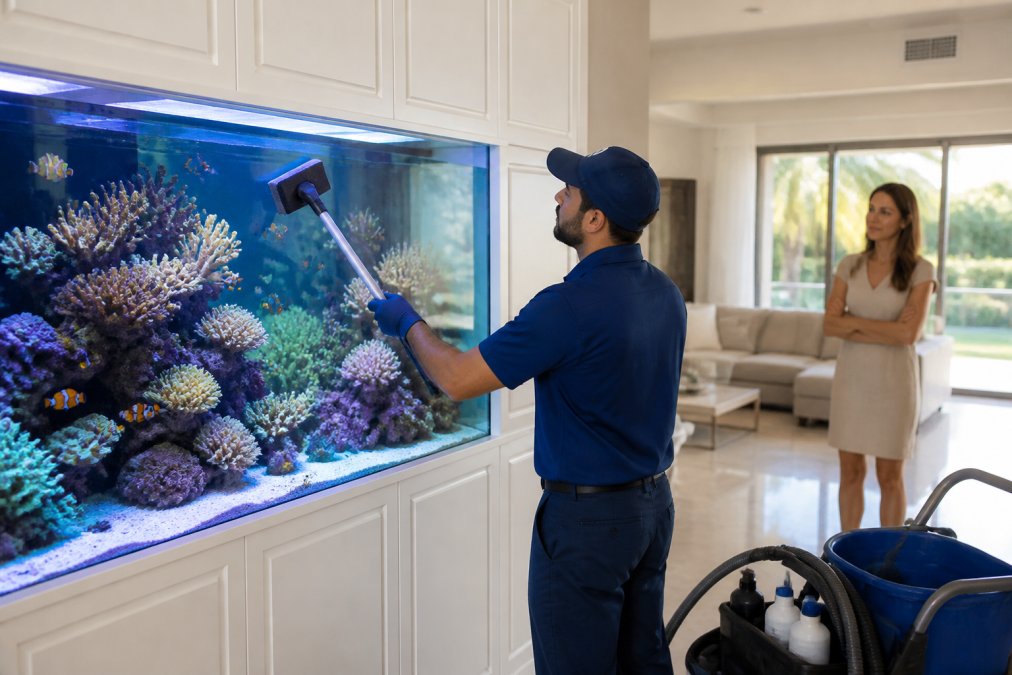
Scheduled Maintenance and Water Quality Testing
Every visit starts with testing, not cleaning. A technician checks salinity, pH, alkalinity, calcium, magnesium, ammonia, nitrite, and nitrate before touching anything. Those numbers determine what the tank actually needs that day.
From there, the routine covers:
- 10-20% water changes with matched temperature and salinity
- Protein skimmer cup cleaning and neck wipe-down
- Filter media inspection and replacement
- Substrate vacuuming and detritus removal
- Glass and acrylic cleaning inside and out
A tank on a biweekly schedule rarely needs emergency intervention. A tank on a "when I remember" schedule almost always does.
Algae Control and Equipment Troubleshooting
Algae is a symptom, not a problem. When a reef tank breaks out in hair algae or cyanobacteria, the cause is usually excess nutrients, insufficient flow, or a filtration component that's quietly failing.
Technicians trace the source. Common culprits include a clogged fleece roller, a skimmer running too wet, or lighting that's past its useful spectrum. Fix the cause and the algae recedes on its own. Scrape the glass and ignore the cause, and it's back in a week.

Aquarium Maintenance Cost: What to Expect and Why
Aquarium maintenance cost varies by tank size, system complexity, and visit frequency. A basic freshwater tank costs less to service than a full reef system with dosing, automation, and sensitive corals. Most professional programs are priced per visit with a monthly or quarterly commitment, and the per-visit rate is usually lower on a weekly or biweekly contract than on a month-to-month arrangement.
What drives the price up or down:
- Tank volume and number of systems (a single 75-gallon reef is priced differently than three tanks on one property)
- Saltwater versus freshwater
- Whether dosing, automation, or a controller is involved
- Travel distance and access to the tank (a tank behind a locked gate or in a tight cabinet takes longer)
- Frequency (weekly, biweekly, monthly)
- Whether consumables are included or billed separately
What a Fair Service Agreement Should Include
Before comparing quotes, ask each provider to itemize the following. A plan that looks cheaper per visit often excludes the items that matter most:
- Water changes and salt mix (or a stated allowance)
- RO/DI top-off water
- Filter media, fleece rolls, and carbon/GFO replacement
- Testing reagents and calibration solution
- Skimmer and pump cleaning labor
- Emergency call-out policy and after-hours rate
- Whether livestock loss during a service visit is covered
A common pattern is a base rate that covers labor and testing, with consumables billed at cost plus a small markup. That structure is not automatically bad, but it should be disclosed up front so you can compare total monthly spend rather than the headline visit price.
The DIY Cost-Benefit Math
DIY maintenance saves money on paper. It costs time, and it costs mistakes. A hobbyist testing alkalinity with a mismatched kit, or missing a slow leak for three weeks, can lose livestock worth far more than a year of service visits.
Run the honest comparison on an annual basis:
- Test kits, reagents, and calibration solution
- Salt mix and RO/DI replacement cartridges
- Filter media and fleece rolls
- Replacement pumps, heaters, and impellers that fail from deferred cleaning
- Your own hours per week, valued at whatever your time is worth
- The cost of one livestock loss event
For a small freshwater tank, DIY usually wins on cost. For a reef system with sensitive corals, the math flips once you price in a single coral loss or a weekend spent chasing a chemistry problem.
For equipment that reduces long-term maintenance demands, the [Red Sea ReefATO+ Automatic Top-Off System(/products/red-sea-reefato-automatic-top-off-system) | blueearthaquariums.com] at $225.00 keeps salinity stable between visits, which cuts down on the correction work a technician has to do each time.
Your Reef Tank Maintenance Checklist for a Healthy System
A reef tank maintenance checklist is the single most useful tool a hobbyist can keep. It turns vague anxiety into a repeatable routine.
Daily and Weekly Tasks
Daily, you're looking at the tank, not testing it. Feed the fish, confirm return pumps and powerheads are running, and glance at temperature and salinity. That's it.
Weekly is where the real work happens:
- Test alkalinity, calcium, and magnesium
- Check salinity with a calibrated refractometer
- Empty and rinse the skimmer cup
- Top off with fresh RO/DI water
- Inspect corals for bleaching, recession, or pests
Monthly and Quarterly Deep Clean
Monthly, pull the skimmer body for a full clean and inspect pump impellers for calcium buildup. Test nitrate and phosphate, and adjust feeding if either is climbing.
Quarterly, deep clean the sump, soak and clean powerheads, replace filter media, and check all plumbing connections for salt creep that signals a slow leak.
| Task | Frequency | Why It Matters |
|---|---|---|
| Feed and visual check | Daily | Catches pump failures early |
| Water change | Biweekly | Dilutes accumulated nutrients |
| Alkalinity and calcium test | Weekly | Prevents coral stress |
| Skimmer deep clean | Monthly | Restores foam production |
| Sump and pump service | Quarterly | Prevents flow loss |
Aquarium Cleaning Tools for Professionals and DIYers
Aquarium cleaning tools for professionals go well beyond a magnetic scraper. The kit that matters includes a long-handled algae scraper, a gravel vacuum, a refractometer, a full test kit, calibration solution, and a dedicated set of buckets used only for the tank.
The single most overlooked tool is a refractometer that's actually calibrated. A salinity reading that's off by a small margin compounds every week and stresses livestock slowly.
For filtration, the Red Sea ReefMat 500 Fleece Roller Filter at $399.99 handles aquariums up to 140 gallons and replaces filter socks entirely. Its smart motor advances the fleece only when needed and alerts you through the ReefBeat App when the roll is running low. For nano and all-in-one systems, the Red Sea NanoMat at $215.00 drops straight into a standard 4-inch filter sock chamber.
DIY vs. Professional Service: A Cost-Benefit Analysis
DIY maintenance saves money on paper. It costs time, and it costs mistakes. A hobbyist testing alkalinity with a mismatched kit, or missing a slow leak for three weeks, can lose livestock worth far more than a year of service visits.
DIY makes sense when:
- The tank is small and freshwater
- You genuinely enjoy the testing and tinkering
- You have the discipline to test on a fixed schedule
Professional service makes sense when:
- The system is a reef tank with sensitive corals
- The tank is in a commercial space where downtime is visible
- You travel or your schedule is unpredictable
- Water chemistry keeps drifting and you're tired of guessing
The honest middle ground: many hobbyists handle daily feeding and weekly testing themselves, then bring in a professional for quarterly deep cleans and equipment troubleshooting. That split keeps costs reasonable without letting the system drift.
Water Chemistry for Local Tap Water and Disaster Preparedness
Tap water is not tank water. Even treated municipal supply can carry phosphate, nitrate, and trace elements that fuel algae and destabilize a reef. Along the southeastern coast, source water is typically drawn from a mix of surface and well supplies, and hardness, alkalinity, and chloramine levels can shift with rainfall and seasonal demand. The fix is a quality RO/DI unit and a test of the source water before it ever touches the tank.
What to Test in Your Source Water
Before you blame the tank, test what you are putting into it. A basic source-water panel covers:
- Total dissolved solids (TDS) at the tap and after the RO/DI membrane
- Alkalinity and hardness, which affect how your salt mix buffers
- Phosphate and nitrate, the two nutrients most likely to fuel algae
- Chlorine versus chloramine, because chloramine requires a catalytic carbon stage that standard carbon blocks do not fully remove (the EPA)
- Silica, which can drive diatom blooms in new systems
Local water chemistry shifts seasonally, and a source that tested clean in spring can carry different parameters after heavy rainfall. Testing your tap water periodically, not once, tells you whether your filtration is keeping up. If post-membrane TDS starts climbing, the resin or membrane is exhausted and the unit is passing contaminants into your tank.
Disaster Preparedness for Power Outages and Storms
Disaster preparedness matters more than most hobbyists admit. A power outage of a few hours drops temperature and stops circulation, which is enough to stress or kill sensitive livestock (PubMed). In a region where extended outages are a real seasonal risk, the plan should be written down before the storm, not improvised after it.
- Keep battery-powered air pumps on hand for outages, and test the batteries quarterly
- Have a plan to maintain temperature during extended power loss, including a way to float bags of warm water or run a small inverter off a car battery
- Never run a generator indoors or in an attached garage (the CDC)
- Keep a spare heater and return pump on the shelf, sized for the tank
- Stock several days of RO/DI water and mixed saltwater before a storm is forecast
- Photograph the system and equipment for insurance purposes before the season starts
A short outage is survivable with a battery air pump and a blanket over the tank. A multi-day outage is where a written plan and a spare pump make the difference between a stressed tank and a total loss.
The Red Sea Reefer DC Skimmer 900 at $659.00 handles nutrient export for systems up to 240 gallons, and its ReefRun DC pump gives you Wi-Fi control through the ReefBeat App, so you can confirm it's running after power returns without opening the cabinet.
For dosing stability, the Red Sea ReefDose 4 at $449.00 delivers four independent dosing heads with accuracy down to 0.05 mL, which removes the guesswork from calcium and alkalinity maintenance.
Frequently Asked Questions
How much does it cost to have someone clean your fish tank?
Professional aquarium cleaning services in West Palm typically charge based on tank size, type, and frequency. This price often includes water changes, glass cleaning, filter maintenance, and water testing. For larger or more complex systems, expect higher rates. At Blue Earth Corals and Aquariums, we provide a detailed quote after assessing your specific setup and needs.
What services are included in professional aquarium maintenance?
A standard maintenance visit covers water changes, substrate vacuuming, glass and acrylic cleaning, filter media replacement, protein skimmer cleaning, and water parameter testing. Technicians also inspect equipment like pumps and heaters for wear. For reef tanks, services may include coral health checks and dosing adjustments. Our checklist ensures every critical component is serviced, from the filtration system to equipment checks, keeping your aquatic life healthy and your tank looking its best.
How often should a saltwater aquarium be professionally cleaned?
Most saltwater aquariums benefit from professional cleaning every two to four weeks. High-bioload reef tanks with many fish and corals may need weekly service to maintain stable water chemistry and prevent algae outbreaks. A lightly stocked freshwater tank might go a month between visits. Your technician will recommend a schedule based on your tank's specific needs, including filtration capacity and livestock health, to ensure consistent water quality and a thriving ecosystem.
How do I choose a reliable aquarium cleaning service?
Look for a service with proven experience, transparent pricing, and a clear maintenance checklist. Ask about their approach to water chemistry, algae control, and emergency repair. A reliable provider will offer a consultation, explain their process, and provide references. Check if they are insured and have a physical location. At Blue Earth Corals and Aquariums, our 19+ years of experience and aquaculture facility in West Palm Beach mean we understand local water conditions and can tailor a plan for your tank.
How to Acclimate Saltwater Fish Safely: 2026 Guide
What to Look for in Healthy Corals: 2026 Reef Guide
Related Posts

How to Choose the Right Coral Lighting

SPS vs LPS Coral Care Requirements

Design a 75 Gallon Reef Tank: Complete Setup Guide

Coral Acclimation Guide for Hobbyists: 2026 Edition

Professional Reef Tank Installation Cost: 2026 Guide

How to Prevent Fish Disease Introduction: 7 Steps

Troubleshooting Common Reef Tank Problems: 2026 Guide
