

Reef Tank Design for Small Spaces: A How-To Guide
Table of Contents
- Reef Tank Design for Small Spaces: Planning Your Nano Aquascape
- Choosing the Right Tank Shape and Footprint
- Best Equipment for Starting Saltwater Tanks in Compact Systems
- Aquascaping Techniques That Maximize Vertical Space
- Water Chemistry and Parameter Management in Small Volumes
- Nano Reef Tank Maintenance Tips for Long-Term Stability
- Selecting Beginner-Friendly Corals for Limited Space
- Common Mistakes to Avoid When Designing Small Reef Tanks
- Frequently Asked Questions
Last Updated: September 26, 2026
Reef Tank Design for Small Spaces: Planning Your Nano Aquascape
Creating a thriving reef ecosystem in a small space isn't just possible, it's become one of the most rewarding challenges in the hobby. At Blue Earth Corals and Aquariums, we've worked with reef keepers who started with limited square footage and ended up with stunning aquascapes that rival much larger systems. The key isn't fighting your constraints; it's designing within them.
Reef tank design for small spaces requires a different mindset than building a traditional 75-gallon setup. You're working with tighter water parameters, higher nutrient concentration, and less room for error. But here's what most people miss: those constraints actually force better planning, more intentional aquascaping, and ultimately, healthier corals.
This guide walks you through the practical steps to design and maintain a nano reef that thrives. We'll cover tank selection, equipment essentials, aquascaping techniques, and the specific maintenance routines that keep small systems stable. Whether you're working with 10 gallons or 40 gallons, these principles apply.
Choosing the Right Tank Shape and Footprint
The first decision shapes everything that comes after. Tank shape determines how you arrange rock, where you place equipment, and how water flows through your system. It's not just about aesthetics, it's about function.
Rimless vs. Peninsula vs. Cube Configurations
Rimless tanks give you clean sightlines and maximum usable space. The open top means easier access for maintenance and better gas exchange. For reef tank design for small spaces, rimless works best when you have wall space and want a modern look. The tradeoff: no frame support means thicker glass and higher cost.
Peninsula tanks sit perpendicular to a wall, giving you viewing from three sides. They're excellent for corner placement and create a focal point in a room. The downside is reduced footprint efficiency, you lose some internal volume compared to a standard rectangular tank of the same dimensions.
Cube configurations pack the most volume into the smallest footprint. A 40-gallon cube (24" x 24" x 24") gives you more water mass and stability than a 40-gallon breeder tank (36" x 18" x 18"). For nano systems, that extra water volume matters. Cubes also work well on stands or shelving. The challenge: limited horizontal space for aquascaping and flow patterns.
For most hobbyists starting with nano reef tank design, a rimless rectangle 36" x 18" x 18" (40 gallons) or 24" x 24" x 24" (40-gallon cube) offers the best balance. You get enough volume to maintain stable water parameters without overwhelming your space.
Best Equipment for Starting Saltwater Tanks in Compact Systems
Small tanks demand efficient equipment. You can't hide bulky filters or oversized powerheads. Every piece needs to earn its space.
Filtration, Flow, and Protein Skimming Essentials
Mechanical filtration is your first line of defense. In small volumes, detritus accumulates quickly and breaks down into nitrate and phosphate. The Red Sea NanoMat Automatic Fleece Roller Filter ($215.00) solves this problem with continuous mechanical filtration in a compact footprint. It fits into standard 4" filter sock chambers and automatically advances fleece to remove waste before it decays. For tanks up to 35 gallons, this keeps your water remarkably clean without daily filter sock changes.

Biological filtration happens in your rock and substrate. Live rock rubble provides surface area for beneficial bacteria. In a nano system, aim for 1.5 to 2 pounds of live rock per gallon, that's 60-80 pounds in a 40-gallon tank. This might seem like a lot, but it's your biological engine.
Protein skimming removes dissolved organics before they become bioload. The IceCap K1 Neo Protein Skimmer ($69.29) is built for pico and nano tanks from 5 to 15 gallons. Its 1.98-inch body diameter fits into rear overflow chambers. It pulls waste out of the water column, reducing the nutrient load that feeds algae blooms.
Water flow prevents dead zones and keeps corals healthy. The IceCap Gyre 2K Flow Pump with Basic Controller ($194.24) creates cross-flow circulation across your entire tank. Unlike traditional powerheads that blast one spot, gyres push a broad sheet of water that circulates completely. For 20-90 gallon systems, this means zero stagnant corners.
For larger nano systems (30-50 gallons), the EcoTech Marine VorTech MP10 QuietDrive ($379.99) delivers up to 1,500 GPH with wireless control and near-silent operation. The magnetically coupled motor means no cords inside the tank, preserving your clean aesthetic.
Lighting and Spectrum for Coral Growth
Lighting drives photosynthesis in zooxanthellate corals. In small tanks, you can't hide mediocre lighting. Your corals will tell you immediately if something's wrong.
LED systems dominate nano setups. They run cool, consume minimal power, and let you dial in specific spectrum. Most quality LED fixtures for nano tanks include:
- Blue spectrum (420-450nm) for coral coloration
- White spectrum (5,000-6,500K) for growth
- Red spectrum (630-680nm) for photosynthesis
Intensity matters too. Most SPS corals need 150-250 PAR (photosynthetically active radiation) at the coral surface. LPS corals thrive at 50-150 PAR. Start with a fixture rated for your tank size, then measure PAR with a meter to dial in placement.
Red Sea NanoMat Automatic Fleece Roller →
For a 40-gallon nano, a single quality LED fixture positioned 6-12 inches above the water surface works well. Mount it on an adjustable arm so you can fine-tune height as corals grow.
Aquascaping Techniques That Maximize Vertical Space
This is where reef tank design for small spaces becomes an art. You're not trying to recreate a natural reef, you're creating a three-dimensional composition that draws the eye upward and makes the tank feel larger than it is.
Using the Rule of Thirds and Creating Overhangs
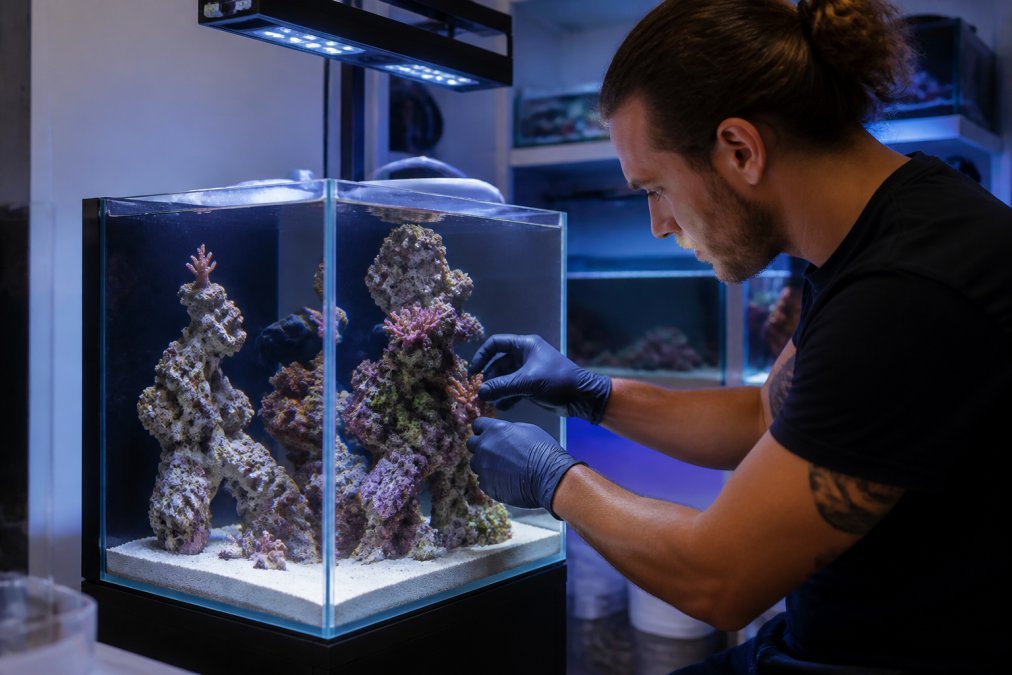
The rule of thirds comes from photography and design. Divide your tank into a 3x3 grid (mentally or with tape). Place your focal points, the tallest rock structures, most colorful corals, along the intersection lines, not dead center. This creates visual interest and makes the space feel more intentional.
In a nano tank, apply this vertically. Your tallest rock structures should reach about two-thirds of the tank height, leaving space above for light penetration and water surface movement. Position them slightly off-center, not in the middle of the tank.
Overhangs and ledges add depth and create swim-throughs for fish. Use epoxy or aquarium-safe adhesive to bond rock pieces at angles. A small overhang on the back-left of your tank creates a shaded area for light-sensitive corals while making the aquascape feel more complex than it actually is.
Vertical orientation is key.
Water Chemistry and Parameter Management in Small Volumes
Small water volume means parameters swing faster. A missed feeding or forgotten water change hits harder in 40 gallons than in 200 gallons. This isn't a weakness, it's just reality. Plan for it.
Nano Reef Tank Maintenance Tips for Long-Term Stability
Consistency beats perfection. A simple routine performed reliably keeps systems stable longer than sporadic heroic efforts.
Weekly tasks:
- Test salinity, alkalinity, and pH
- Perform 20-30% water change
- Clean powerhead intake and filter sock
- Check for algae blooms or pest outbreaks
- Feed corals and fish appropriately
Monthly tasks:
- Test calcium, magnesium, nitrate, and phosphate
- Clean light fixture lens
- Inspect all equipment for wear
- Top off auto top-off reservoir
Quarterly tasks:
- Deep clean the sump or filter chamber
- Check all plumbing connections
- Review stocking density and feeding amounts
Selecting Beginner-Friendly Corals for Limited Space
Not all corals suit nano systems. Some grow too fast and take over. Others need more flow or light than small tanks can provide. Choose wisely.
Common Mistakes to Avoid When Designing Small Reef Tanks
Overstocking is the number one mistake. A 40-gallon tank isn't "almost a 50-gallon tank." It's a 40-gallon tank with all the constraints that entails. Stock conservatively. Two small fish and a handful of corals beats six fish fighting for space.
| Task | Frequency | Impact |
|---|---|---|
| Water change (20-30%) | Weekly | Removes excess nutrients, maintains stability |
| Parameter testing | Weekly | Catches problems early |
| Filter sock/fleece cleaning | Weekly | Prevents detritus breakdown |
| Equipment inspection | Monthly | Catches wear before failure |
| Deep sump cleaning | Quarterly | Maintains biological filtration |
Frequently Asked Questions
What is the minimum tank size for a beginner reef tank?
Most beginners succeed with 20-30 gallon reef tanks, though nano systems as small as 10-15 gallons are viable with proper planning. Smaller volumes require more frequent water parameter monitoring because salinity, temperature, and nutrient levels swing faster. If you're new to saltwater, a 20-gallon minimum gives you more margin for error and makes maintenance less demanding. Nano reef tank maintenance tips focus on consistent dosing and water changes, smaller tanks magnify mistakes, so stability matters most.
How do you maximize flow in a small reef tank?
Use a gyre-style or cross-flow pump rather than a single directional powerhead. Gyre pumps push a broad sheet of water across the tank instead of a concentrated blast, eliminating dead zones in corners and along the substrate. Position your pump intake low and outlet high to create circular motion. The IceCap Gyre 2K ($194.24) delivers this efficient cross-flow pattern in tanks up to 90 gallons, keeping detritus suspended so your filter can remove it before it decays into excess nutrients.
What are the most common mistakes when designing a small reef tank?
Overcrowding corals is the biggest error, nano tanks look bare when first set up, so hobbyists pack in too many colonies. This creates nutrient export problems and limits growth. Second, ignoring water parameters: small volumes mean salinity and calcium swings hit corals harder. Third, using undersized filtration or skimmers. The IceCap K1 NEO ($69.29) is engineered for pico systems 5-15 gallons and actively removes organic waste before it fuels algae. Fourth, poor cable and hose management creates visual clutter and blocks flow paths in tight spaces.
Are peninsula tanks better for small spaces than traditional rectangular tanks?
Peninsula tanks offer viewing angles from three sides, making them ideal for desks or room corners where a standard rectangular tank only shows one face. They also use floor space more efficiently in tight rooms. However, they reduce usable interior volume compared to a rectangular tank of similar footprint, making water parameter stability slightly trickier. Choose a peninsula if your space is corner-bound; choose a rimless rectangular tank if you want maximum volume in the same floor footprint.
Stable Reef Water Parameters: A 2026 How-To Guide
Living Art Aquariums vs Corals.com: Which Fits Your Reef?
Related Posts

Coral Fragging for Beginners: Step-by-Step Guide

How to Improve Coral Health: A Reef Tank Guide

Why Corals Die After Introduction: Prevention Guide

Living Art Aquariums vs Corals.com: Which Fits Your Reef?

Stable Reef Water Parameters: A 2026 How-To Guide

Avoiding Coral Shipping Damage: 7 Proven Tips
