

Stable Reef Water Parameters: A 2026 How-To Guide
Table of Contents
- Why Stable Reef Water Parameters Matter More Than Perfect Numbers
- Essential Water Parameters to Test and Their Optimal Ranges
- Your Reef Tank Water Testing Schedule: Daily, Weekly, and Monthly
- How to Manage Salinity and Evaporation with an Auto Top-Off System
- Dosing vs. Water Changes: Which Keeps Parameters Stable?
- Best Reef Tank Supplements for Growth and How to Dose Them Safely
- Signs of Coral Stress from Parameter Swings and How to Respond
- Automation and Troubleshooting: Tools That Keep Reef Water Parameters Stable
- Frequently Asked Questions
Last Updated: September 25, 2026
Why Stable Reef Water Parameters Matter More Than Perfect Numbers
Chasing a perfect number on a test kit is a losing game. Stable reef water parameters matter more than hitting an exact target, because corals adapt to consistency, not a single reading. This guide from Blue Earth Corals and Aquariums shows you how to keep your reef steady instead of perfect.
Essential Water Parameters to Test and Their Optimal Ranges
The core parameters to test are alkalinity, calcium, magnesium, salinity, pH, nitrate, and phosphate. Here is the quick version:
| Parameter | Target Range | Why It Matters |
|---|---|---|
| Alkalinity (KH) | 7-9 dKH | Builds skeleton, buffers pH |
| Calcium | 400-450 ppm | Coral and coralline growth |
| Magnesium | 1300-1400 ppm | Keeps calcium and KH in balance |
| Salinity | 1.024-1.026 SG | Controls all other chemistry |
| pH | 8.0-8.4 | Affects coral metabolism |
| Nitrate | 1-10 ppm | Too high fuels algae |
| Phosphate | 0.03-0.10 ppm | Too high stunts coral |
Alkalinity, Calcium, and Magnesium: The Big Three
Alkalinity, calcium, and magnesium are the three you cannot ignore. Alkalinity buffers pH and supplies carbonate for skeletons, calcium builds those skeletons, and magnesium keeps calcium and alkalinity from crashing into each other.
Salinity, pH, Nitrate, and Phosphate
Salinity sets the stage for everything else. Get it wrong and every other reading is off. Use a calibrated refractometer, not a swing-arm hydrometer, and check it monthly.
Your Reef Tank Water Testing Schedule: Daily, Weekly, and Monthly
A reef tank water testing schedule keeps small problems from becoming big ones. Match the test to how fast the parameter can move:
- Daily: salinity (visual check), temperature, and alkalinity if you dose heavily
- Weekly: alkalinity, calcium, magnesium, nitrate, phosphate, pH
- Monthly: full panel plus refractometer calibration
- Quarterly: check test kit expiration dates and replace reagents
How to Manage Salinity and Evaporation with an Auto Top-Off System
Evaporation removes fresh water and leaves salt behind, so salinity climbs any time top-off water is not replaced. The rate scales with surface area, room temperature, airflow, and humidity: a covered 40-gallon breeder in a cool basement may lose a quarter gallon a day, while an open 120-gallon system in a dry, air-conditioned room can lose two gallons or more.
The Evaporation Math You Should Actually Run
Salinity is a ratio, so a small water loss produces a measurable shift. As a working rule, losing about 1% of total system volume raises specific gravity by roughly 0.001, under a gallon on a 75-gallon system, roughly 2 gallons on a 200-gallon system. Large tanks feel forgiving; nano tanks punish a missed top-off within a day.
Two practical consequences follow:
- Mark your sump. Put a piece of tape at the normal operating water line. A glance tells you whether the ATO is keeping up.
- Size the reservoir for your worst week. If your system evaporates a gallon a day in winter and two in summer, a 10-gallon reservoir covers a long weekend but not a two-week vacation.
Seasonal and Environmental Effects Most Guides Skip
Evaporation is not constant across the year, and the variables are usually in the room, not the tank:
- Ambient humidity. A dry winter forced-air heating system pulls moisture out of the air and accelerates evaporation. A humid summer with windows open does the opposite.
- Room temperature swings. A tank running warmer than the room loses more water; a tank in a cold room with a heater working hard loses more still.
- Airflow. A fan over the sump or an open canopy increases evaporation and cooling. That is useful in summer and costly in winter.
- Air conditioning. Central AC dehumidifies the whole house, so summer evaporation can rival winter in a tightly sealed home.
Choosing and Configuring an Auto Top-Off System
An ATO replaces evaporated water with fresh RO/DI water. The core requirements: a reliable water-level sensor, a pump or solenoid sized to the head height, and a fail-safe that stops the pump if the sensor sticks.
Key configuration points:
- Never top off with saltwater. Fresh water only. Topping off with saltwater raises salinity over time and is one of the most common causes of a slow, unexplained climb.
- Use a redundant shutoff. A float switch plus a maximum-run timer, or a second sensor, prevents a stuck-on pump from flooding the sump with fresh water and crashing salinity.
- Keep the reservoir covered. An open reservoir evaporates too, concentrates nothing useful, and collects dust.
- Route the top-off line above the water line. A siphon back into the reservoir can drain it when the pump stops.
Calibrating Your Refractometer So the Reading Means Something
An ATO handles daily replacement but does not fix salinity problems caused by salt creep, a leaking fitting, or a skimmer pulling too much water. If salinity drifts despite a working ATO, check those first.
Dosing vs. Water Changes: Which Keeps Parameters Stable?
Water changes and dosing are not competing strategies, they solve different problems, and the right mix depends on your tank's consumption rate and bioload. The useful question is not "which one" but "how much of each, and when."
What Each Method Actually Does
- Water changes dilute accumulated waste (nitrate, phosphate, dissolved organics) and replenish trace elements in roughly the proportions found in fresh saltwater. They do not hold alkalinity, calcium, or magnesium steady between changes unless the changes are large and frequent.
- Dosing adds specific ions to replace what corals and coralline algae consume. It holds the big three steady day to day but does nothing for accumulated nutrients or depleted trace elements.
Rely on water changes alone and your alkalinity will sawtooth between changes, up after a change, down as corals consume it. Rely on dosing alone and nitrate and phosphate climb while trace elements deplete. Most stable systems run both.
Neptune Systems Trident Automated Water →
Consumption Rate Is the Real Variable
The amount you need to dose is set by demand, and demand tracks coral mass and growth. A tank full of fast-growing stony corals can consume 1-2 dKH of alkalinity per day or more, while a lightly stocked soft-coral tank may consume a fraction of that. The more coral tissue and skeleton you grow, the harder stability becomes.
A practical way to find your consumption rate:
- Test alkalinity, calcium, and magnesium at the same time two days in a row without dosing.
- Note the drop in each.
- That daily drop is your baseline demand. Set your dose to replace it, then re-test weekly and adjust.
When to Dose vs. When to Change Water
Use this decision logic:
| Situation | First Action | Why |
|---|---|---|
| Alkalinity, calcium, or magnesium drifting down steadily | Dose to match consumption | These are consumed continuously; water changes alone cannot keep pace |
| Nitrate or phosphate rising | Water change, plus review feeding and filtration | Dosing does not remove nutrients |
| Trace elements possibly depleted | Water change | Fresh saltwater replenishes them in balanced proportions |
| One parameter swinging while others hold | Test twice, then investigate | A single outlier is often a test error or a magnesium imbalance |
| Everything drifting together | Check salinity first | Salinity errors shift every other reading |
A common mistake is using a water change to fix an alkalinity drop: a 20% change on a tank consuming 1.5 dKH per day buys a few hours, not stability. Conversely, dosing to fix a nitrate problem does nothing, that is a water-change and husbandry issue.
Dosing Safely: Rates and Limits
Precision matters more than volume. Dose in small, consistent amounts and change one parameter at a time:
- Raise alkalinity no more than about 1 dKH per day.
- Raise calcium no more than about 50 ppm per day.
- Test before every adjustment, and log the result.
- Keep magnesium in range first, low magnesium makes calcium and alkalinity behave unpredictably even when you dose them correctly.
Water Change Sizing and Frequency
Automation helps here: a controller that logs alkalinity trends and a doser on a fixed schedule remove the two biggest causes of drift, missed tests and inconsistent dosing. But automation does not replace the consumption-rate test. Run it quarterly as your coral grows, because demand rises with biomass.
Best Reef Tank Supplements for Growth and How to Dose Them Safely
The best reef tank supplements for growth are the ones you dose in small, consistent amounts, not the ones you dump in when something looks off. Coral growth comes from steady alkalinity, calcium, and magnesium, plus trace elements water changes may not fully replace.
Dose safely with these rules:
- Test before you dose, every time
- Change one parameter at a time
- Raise alkalinity no more than 1 dKH per day
- Raise calcium no more than 50 ppm per day
- Keep a log so you can spot trends
Signs of Coral Stress from Parameter Swings and How to Respond
The signs of coral stress from parameter swings show up before the coral dies. Watch for:
- Closed polyps that stay closed for days
- Pale or bleached tissue
- Slimy or receding edges
- Sudden color loss
- Slowed or stopped growth
Automation and Troubleshooting: Tools That Keep Reef Water Parameters Stable
Automation removes the two biggest causes of drift: missed tests and inconsistent dosing. A controller that tests and doses for you keeps reef water parameters in range even when you are away.
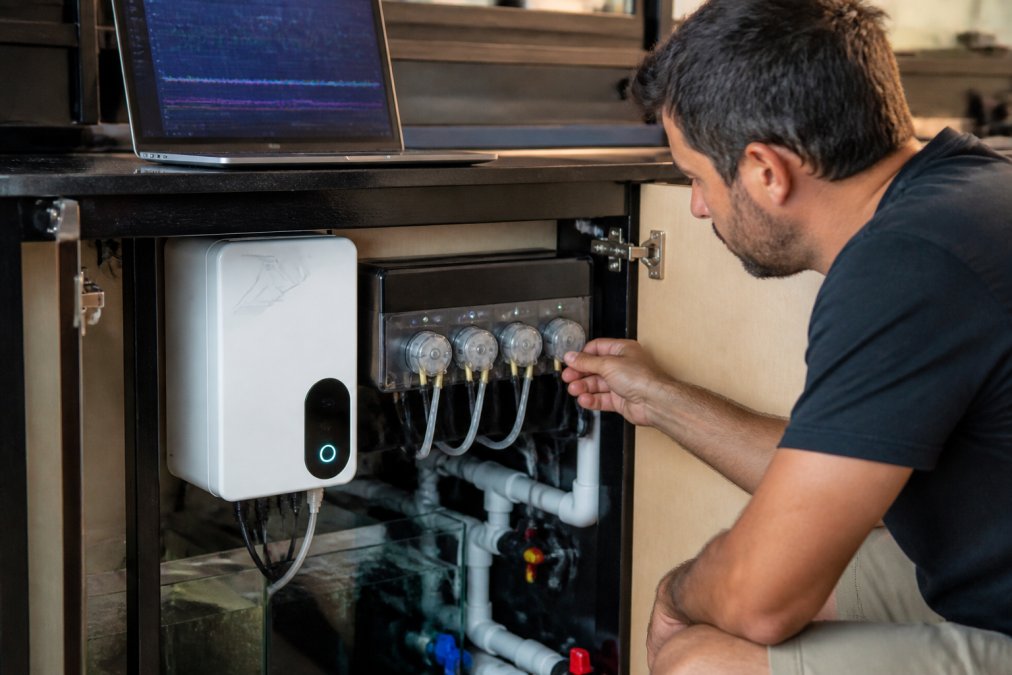
Here is a quick troubleshooting flow for common problems:
| Symptom | Likely Cause | First Fix |
|---|---|---|
| Alkalinity dropping fast | Heavy coral load, low dosing | Increase dose, test daily |
| Calcium high, KH low | Imbalance, low magnesium | Test magnesium, adjust |
| Salinity creeping up | Evaporation, no top-off | Add ATO, top off with fresh water |
| Nitrate rising | Overfeeding, low filtration | Cut feeding, add biological filtration |
Frequently Asked Questions
What should my water parameters be for a reef tank?
For most mixed reefs, aim for alkalinity 7-9 dKH, calcium 400-450 ppm, magnesium 1300-1400 ppm, salinity 1.024-1.026 SG, pH 8.1-8.4, nitrate under 10 ppm, and phosphate under 0.1 ppm. These ranges support coral growth and keep reef water parameters stable. Test regularly and adjust slowly, since sudden shifts stress corals more than a slightly off number.
How often should I test my reef tank water parameters?
A practical reef tank water testing schedule is: alkalinity and calcium every 1-2 days, magnesium weekly, salinity and temperature daily, and nitrate and phosphate weekly. If you use an automated analyzer like the Neptune Systems Trident, you can test alkalinity, calcium, and magnesium up to 24 times per day. Consistency matters more than testing everything at once.
How do dosing pumps help maintain reef tank stability?
Dosing pumps deliver small, precise amounts of alkalinity, calcium, magnesium, or trace elements on a set schedule. This avoids the swings caused by manual dosing or large water changes. The Red Sea ReefDose 4, for example, has four independent heads with accuracy down to 0.05 mL per dose. Paired with regular testing, a dosing pump keeps reef water parameters steady and reduces the risk of coral stress from parameter swings.
What are the signs of coral stress from parameter swings?
Common signs include retracted polyps, pale or bleached tissue, slowed growth, and sudden algae blooms. SPS corals may show tip burn or tissue necrosis, while LPS corals can inflate or shrink unevenly. If you notice these signs, test alkalinity, calcium, and salinity immediately. Correcting a swing slowly over several hours is safer than a rapid fix.
Avoiding Coral Shipping Damage: 7 Proven Tips
Reef Tank Design for Small Spaces: A How-To Guide
Related Posts

Coral Fragging for Beginners: Step-by-Step Guide

How to Improve Coral Health: A Reef Tank Guide

Why Corals Die After Introduction: Prevention Guide

Living Art Aquariums vs Corals.com: Which Fits Your Reef?

Reef Tank Design for Small Spaces: A How-To Guide

Avoiding Coral Shipping Damage: 7 Proven Tips
