

Best Reef Tank Supplements for Growth
Table of Contents
- Best Reef Tank Supplements for Growth: Quick Comparison
- Understanding Essential Reef Tank Water Parameters
- 1. Seachem Reef Plus: Full-Spectrum Support
- 2. Fauna Marin Ready2Reef Powder: All-in-One Coral Supplements
- 3. Red Sea Reef Energy AB+ Plus: Nutritional Superfood
- Establishing Your Reef Tank Dosing Schedule
- Automated Dosing vs. Manual Dosing
- Troubleshooting Supplement Reactions and Parameter Swings
- Supplement Interaction and Compatibility
- Choosing the Right Supplement for Your Tank Size
- Cost-Per-Gallon Analysis
- Final Recommendations from Blue Earth Corals and Aquariums
- Frequently Asked Questions
Last Updated: September 2, 2026
Best Reef Tank Supplements for Growth: Quick Comparison
Maintaining a thriving reef tank comes down to water chemistry. Get the fundamentals right, and your corals explode with growth. Get them wrong, and you're watching polyps retract and colors fade.
This guide from Blue Earth Corals and Aquariums breaks down the best reef tank supplements for growth, the ones that actually move the needle on calcification, coloration, and polyp extension. We offer a range of products to help you achieve results and understand how to dose them without crashing your parameters.
Quick Picks:
- Best Overall: Seachem Reef Plus, comprehensive spectrum of trace elements, vitamins, and amino acids for all coral types
- Best All-in-One: Fauna Marin Ready2Reef Powder, simplifies dosing by combining calcium, magnesium, alkalinity, and trace elements
- Best for Nutrition: Red Sea Reef Energy AB+ Plus, superfood approach that boosts energy and coloration without nutrient spikes
| Supplement | Type | Key Benefit | Best For |
|---|---|---|---|
| Seachem Reef Plus | Liquid | Trace elements + vitamins + amino acids | General coral health and growth |
| Fauna Marin Ready2Reef | Powder | All-in-one macro and micro elements | Simplified dosing routines |
| Red Sea Reef Energy AB+ | Liquid | Complete nutrition (carbs, amino acids, vitamins) | Coloration and energy boost |
| Seachem Reef Pack Enhancer | Multi-part | Calcium + strontium + iodide | Accelerated growth in dense tanks |
| Aquaforest AF Growth Boost | Powder | Amino acids + calcium carbonate | Frag adaptation and skeletal growth |
Understanding Essential Reef Tank Water Parameters
Before adding any supplement, understand what you're maintaining. Three parameters control everything: calcium, alkalinity, and magnesium.
Calcium is the building block for skeletal growth. Maintain 400-450 ppm; below 380 ppm, calcification slows dramatically and colors fade (peer-reviewed research).
Alkalinity (8-12 dKH) stabilizes pH and directly impacts calcification rates. Without it, pH crashes and corals stop feeding.
Magnesium comprises roughly 1,350 ppm in healthy seawater and is essential for the enzyme systems regulating calcification. Without adequate magnesium, calcium and alkalinity can't be used efficiently, even if numbers look perfect.
Beyond the Big Three, trace elements like strontium, iodide, and boron support zooxanthellae health, enhance coloration, and improve polyp extension. Most salt mixes contain only a fraction of what natural seawater provides.
1. Seachem Reef Plus: Full-Spectrum Support
Seachem Reef Plus fills gaps that most salt mixes leave behind. This liquid supplement delivers trace elements, vitamins (B12, C), and amino acids in a single bottle. The formula is nitrate and phosphate-free, so you can dose daily without triggering algae blooms.
The amino acid profile supports tissue growth and coloration. Trace elements maintain the ion balance that underpins skeletal density. You can also pre-soak frozen foods to boost nutritional value before feeding.
The downside: Reef Plus doesn't address calcium, alkalinity, or magnesium. If those parameters are crashing, this supplement alone won't save your tank. For established tanks with stable parameters, Reef Plus works beautifully.
Dosing is straightforward, follow the label for your tank volume. Most users dose 2-3 times per week and see visible improvements in polyp extension within 2-3 weeks.
2. Fauna Marin Ready2Reef Powder: All-in-One Coral Supplements
Ready2Reef Powder combines calcium, magnesium, alkalinity, and trace elements into a single, highly concentrated powder. One bottle replaces three, simplifying mixing and dosing.
The formula uses organic calcium and magnesium salts for superior bioavailability, corals can actually use what you're adding. Ready2Reef works for both new tank startups and established systems.
The catch: Ready2Reef is highly concentrated. Monitor parameters closely during the first week. Dose conservatively and test daily. Overdosing causes precipitation, which crashes calcium and creates a nutrient export spiral taking weeks to recover from.
For a 75-gallon reef tank, expect to dose every other day once dialed in. The powder mixes easily in fresh water before adding to the tank.
3. Red Sea Reef Energy AB+ Plus: Nutritional Superfood
Red Sea Reef Energy AB+ Plus delivers complete nutrition, carbohydrates, amino acids, vitamins, and fatty acids, supporting energy production that drives growth and coloration. Corals with adequate energy extend polyps more aggressively and show richer colors.
The formula doesn't spike nutrient levels, so you can dose more aggressively without triggering algae blooms. It's compatible with automatic dosers for consistent results.
The downside: Reef Energy AB+ doesn't replace calcium and alkalinity supplementation. Use it as an addition to a core supplementation plan, not as a standalone solution.
Most users see visible improvements in polyp extension and coloration within 5-7 days.
Establishing Your Reef Tank Dosing Schedule
Most hobbyists fail by adding supplements haphazardly. A dosing schedule is non-negotiable for consistent growth.
Start by testing baseline calcium, alkalinity, and magnesium. Once you have baselines, calculate how much each parameter drops daily. Calcium typically drops 5-15 ppm daily; alkalinity drops 0.5-2 dKH daily (peer-reviewed research). These consumption rates tell you exactly how much supplement to add.
Most reef supplements are dosed daily or every other day. Seachem Reef Plus is typically dosed 2-3 times per week. Fauna Marin Ready2Reef is dosed every other day. Red Sea Reef Energy AB+ can be dosed daily.
Consistency beats perfection. Dosing the same amount at the same time each day creates stability. Your corals adapt to predictable chemistry. Sporadic dosing creates swings that stress corals and trigger algae blooms.
Keep a simple log of doses and test results. After two weeks, you'll see patterns that become your blueprint for long-term stability.
Automated Dosing vs. Manual Dosing
Manual dosing means measuring supplements with a syringe and adding them daily. It takes 5 minutes and gives you complete control. The problem: if you miss a day or miscalculate, parameters swing. Vacation means a crashed tank.
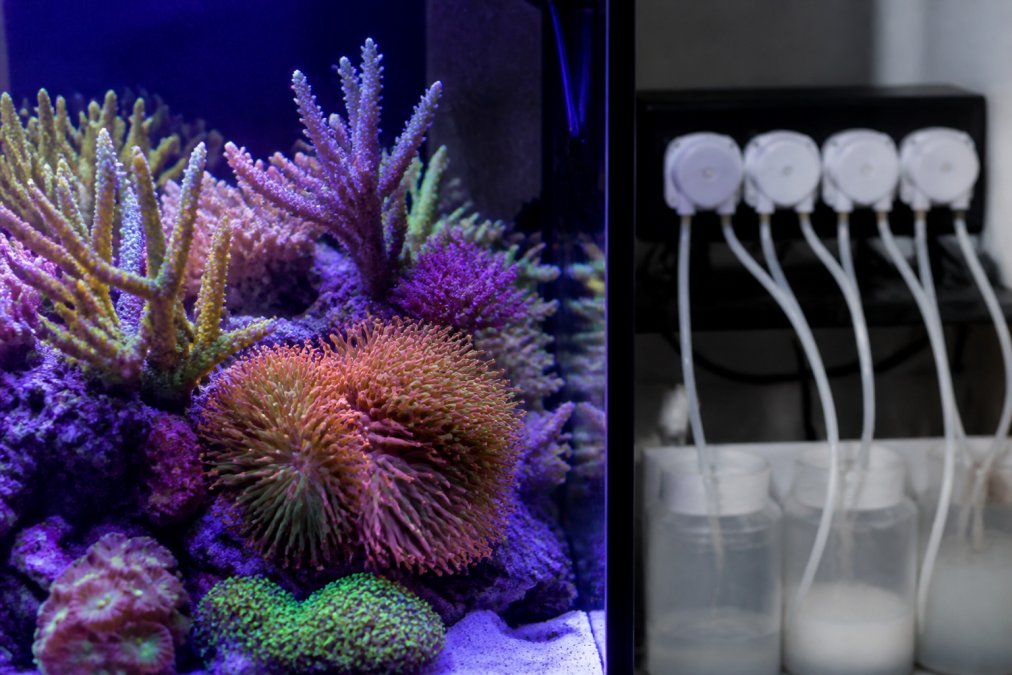
Automated dosing uses a peristaltic pump dispensing exact amounts at programmed intervals. Reliability is unmatched, parameters stay stable because the pump never forgets. The tradeoff: upfront cost of $150-300 for a basic two-head system.
For a 75-gallon reef tank with moderate coral density, manual dosing works if you're disciplined. For anything larger or more densely stocked, automation saves your tank. Blue Earth Corals and Aquariums stocks Red Sea dosing systems that integrate seamlessly with most setups.
Automated systems also provide data. Many modern controllers log dosing history and parameter trends, helping you identify problems before they become catastrophic. If calcium is dropping faster than expected, the logs show it immediately.
Troubleshooting Supplement Reactions and Parameter Swings
The most common reaction is precipitation, which happens when you add too much calcium or alkalinity too quickly. You'll see a white haze in the water column. Fix: do a 25% water change and reduce dosing by half. Test daily for three days, then increase gradually.
Algae blooms after starting supplements usually mean you're overdosing amino acids or energy products. Reduce dosing frequency by 50%. If phosphate exceeds 0.1 ppm or nitrate exceeds 5 ppm, your nutrient export isn't keeping up. Increase skimming or do larger water changes.
Polyp recession after adding supplements signals parameter instability, not supplement failure. Check your test kits. If parameters are truly off, do a 50% water change and stop supplementation for 48 hours.
Some corals react poorly to specific amino acid profiles. If polyp recession occurs only on certain species after starting a new supplement, try switching products. Different manufacturers use different amino acid ratios.
Parameter stability is more important than absolute accuracy. Swings of 20 ppm calcium or 0.5 dKH are more damaging than running consistently at slightly suboptimal levels.
Change one variable at a time when troubleshooting. If you add three new supplements simultaneously and something goes wrong, you won't know which caused it.
Supplement Interaction and Compatibility
Not all supplements play well together. Some combinations create precipitation; others deplete each other.
The safest approach: use products from the same manufacturer line. Seachem's supplements are formulated to work together. Fauna Marin's products are optimized for their system. Red Sea's line is designed as a cohesive program.
If you must mix brands, follow these rules: never combine two all-in-one supplements. Never add calcium and alkalinity supplements within 30 minutes of each other, wait at least an hour. Never dose amino acids and energy products on the same day if also dosing calcium.
The most reliable combination is a primary all-in-one supplement (like Ready2Reef) plus a targeted booster (like Reef Energy AB+ Plus). Avoid chasing every new product on the market. Supplements work best when dosed consistently over months.
Choosing the Right Supplement for Your Tank Size
Nano Reef Tanks (20-40 gallons): Use liquid supplements allowing precise dosing. Seachem Reef Plus is ideal because you can dose 1-2 mL at a time without overshooting parameters. Powder supplements are risky in small tanks. Manual dosing takes 2 minutes.
Standard Reef Tanks (50-100 gallons): All-in-one powders like Ready2Reef shine here. For 75-100 gallons, consider a basic two-head dosing pump for stability.
Large Reef Tanks (150+ gallons): Automated dosing becomes essential. Use a multi-head controller dosing calcium, alkalinity, and a booster supplement on separate schedules. Blue Earth Corals and Aquariums stocks Red Sea full-line systems designed for this scenario.
Coral density also matters. A 75-gallon tank with 40% coral coverage consumes nutrients faster than one with 20% coverage.
Cost-Per-Gallon Analysis
Seachem Reef Plus costs roughly $0.04 per gallon per month. Fauna Marin Ready2Reef runs about $0.06 per gallon per month. Red Sea Reef Energy AB+ Plus is approximately $0.08 per gallon monthly.
For a 75-gallon reef tank, that's $3-6 per month in supplements, $36-72 annually. Compare that to the cost of dead corals or a crashed tank, and supplements become the cheapest insurance you can buy.
Don't cheap out on supplements. Stick with established manufacturers like Seachem, Red Sea, Fauna Marin, and Aquaforest. Their formulations are tested and reliable.
Final Recommendations from Blue Earth Corals and Aquariums
For beginners: Start with Seachem Reef Plus and manually dose it 2-3 times per week. It's forgiving and teaches fundamentals without overwhelming complexity.
For established tanks: Switch to Fauna Marin Ready2Reef Powder for simplicity, or use Red Sea Reef Energy AB+ Plus if prioritizing nutrition and coloration. Pair either with a basic dosing pump.
For advanced hobbyists: Use a multi-head automated system with a primary all-in-one supplement and targeted boosters. Monitor parameters weekly and adjust based on consumption rates.
Consistency beats perfection. A stable dosing routine with average supplements outperforms erratic dosing with premium products. Test weekly, dose at the same time daily, and adjust gradually based on actual numbers.
Blue Earth Corals and Aquariums carries the full Red Sea aquarium systems and supplementation lines. We've tested these products in our West Palm Beach aquaculture facility and trust them completely. Our 19+ years of experience in reef keeping means we recommend only supplements that deliver measurable results.
Frequently Asked Questions
What helps coral reefs grow faster in my tank?
Coral growth depends on three factors: light, water flow, and supplementation. Reef tank supplements provide calcium, alkalinity, magnesium, and amino acids that corals need for skeletal growth and tissue development. Consistent dosing of these elements, combined with stable water parameters and proper lighting, accelerates growth rates. All-in-one coral supplements simplify this by combining multiple elements into a single product, reducing the risk of parameter imbalances that slow growth.
Is there an all-in-one supplement for a reef tank that covers everything?
Yes. All-in-one coral supplements like Fauna Marin Ready2Reef Powder combine calcium, magnesium, alkalinity, and trace elements in one formula. These products simplify dosing by eliminating the need for separate bottles. However, high-demand systems (densely stocked tanks or SPS-heavy setups) may still benefit from targeted supplementation of specific elements like strontium or amino acids for maximum growth.
Do I need to dose supplements if I do regular water changes?
Regular water changes replenish some elements, but not enough for optimal coral growth. Water changes restore trace elements and dilute excess nutrients, but corals consume calcium, alkalinity, and magnesium faster than water changes can replace them. Supplementation fills this gap, maintaining stable parameters and supporting the accelerated growth that hobbyists seek. Without supplements, growth slows significantly even with frequent water changes.
What's the best reef tank dosing schedule for beginners?
Start with a simple all-in-one coral supplement dosed daily according to the manufacturer's instructions. Test your water parameters (calcium, alkalinity, magnesium) twice weekly for the first month to establish a baseline. Once stable, reduce testing to weekly. As you gain confidence, add targeted supplements like amino acids or trace elements. Most beginners succeed with once-daily dosing; advanced keepers often dose multiple times daily using automated pumps for precision.
Can supplements cause algae blooms or harm my corals?
Overdosing supplements can elevate nutrient levels and trigger algae growth, especially with amino acid products. Start with the lowest recommended dose and increase gradually while monitoring parameters. Supplement interactions matter: mixing incompatible products can cause precipitation or parameter swings. Always follow the manufacturer's dosing guidelines, use quality test kits to verify parameters, and introduce one new supplement at a time. If you notice algae or coral stress, reduce dosing and perform a partial water change.
The best reef tank supplements for growth are the ones you'll use consistently. Start simple, test regularly, and adjust based on results. Your corals will reward you with explosive growth and vibrant colors. Get started with Blue Earth Corals and Aquariums, we'll help you find the right supplements and dosing strategy for your specific setup.
This article was written using GrandRanker
Why Is My Coral Losing Color: Causes and Recovery
10 Best Reef Tanks for Beginners 2026
Related Posts

How to Choose the Right Coral Lighting

SPS vs LPS Coral Care Requirements

Design a 75 Gallon Reef Tank: Complete Setup Guide

Coral Acclimation Guide for Hobbyists: 2026 Edition

Professional Reef Tank Installation Cost: 2026 Guide

How to Prevent Fish Disease Introduction: 7 Steps

Troubleshooting Common Reef Tank Problems: 2026 Guide
