

10 Best Reef Tanks for Beginners 2026
Table of Contents
- Quick Comparison Table
- Red Sea REEFER Deluxe 170 G3: Best Compact Reef Tank for Apartments
- Red Sea REEFER Deluxe 250 G3: Best All-In-One System for Beginners
- Red Sea REEFER Deluxe 300 G3 and 350 G3: Best Mid-Size Reef Tanks
- Essential Equipment for Starting a Saltwater Tank
- Cost of Starting a Reef Aquarium: Budget Breakdown for 2026
- Best Coral for Beginner Reef Tanks
- How to Choose Your First Reef Tank: Key Considerations
- Frequently Asked Questions
Last Updated: September 3, 2026
Quick Comparison Table
| Tank Model | Volume | Best For | Starting Price | Key Feature |
|---|---|---|---|---|
| Red Sea REEFER Deluxe 170 G3 | 33 gallons | Apartments & compact spaces | $2,200 | Single ReefLED 115, ReefMat ready |
| Red Sea REEFER Deluxe 250 G3 | 54 gallons | Beginners seeking balance | $3,400 | Dual ReefLED 115, all-in-one system |
| Red Sea REEFER Deluxe 300 G3 | 65 gallons | Mixed reef displays | $3,600 | Larger sump, dual returns |
| Red Sea REEFER Deluxe 350 G3 | 72 gallons | SPS-dominant setups | $3,800 | Maximum light spread, professional grade |
| Red Sea REEFER 250 G3 | 54 gallons | Budget-conscious beginners | $2,399 | Bare system, expandable |
| Red Sea REEFER 425 G3 | 91 gallons | Serious hobbyists | $3,499 | Largest all-in-one option |
Red Sea REEFER Deluxe 170 G3: Best Compact Reef Tank for Apartments
The Red Sea REEFER Deluxe 170 G3 delivers professional-grade performance in just 33 gallons, making it ideal for apartment dwellers and anyone with spatial constraints. The 10-millimeter ultra-clear glass, precision plumbing, and ReefMat-ready sump eliminate common beginner headaches like dead spots and poor water distribution. At $2,200, you're paying for reliability and thoughtful design.


You'll max out around 8-10 small fish and a handful of coral colonies before water chemistry becomes difficult to manage (peer-reviewed research). Beginners who respect this constraint see thriving displays. Blue Earth Corals and Aquariums stocks the 170 G3 with local delivery and installation available. We typically recommend pairing this with the Red Sea ReefATO+ to handle evaporation automatically.
Red Sea REEFER Deluxe 250 G3: Best All-In-One System for Beginners
The Red Sea REEFER Deluxe 250 G3 hits the sweet spot at 54 gallons, where water chemistry stabilizes more easily, stocking options expand significantly, and it still fits in a standard living room.

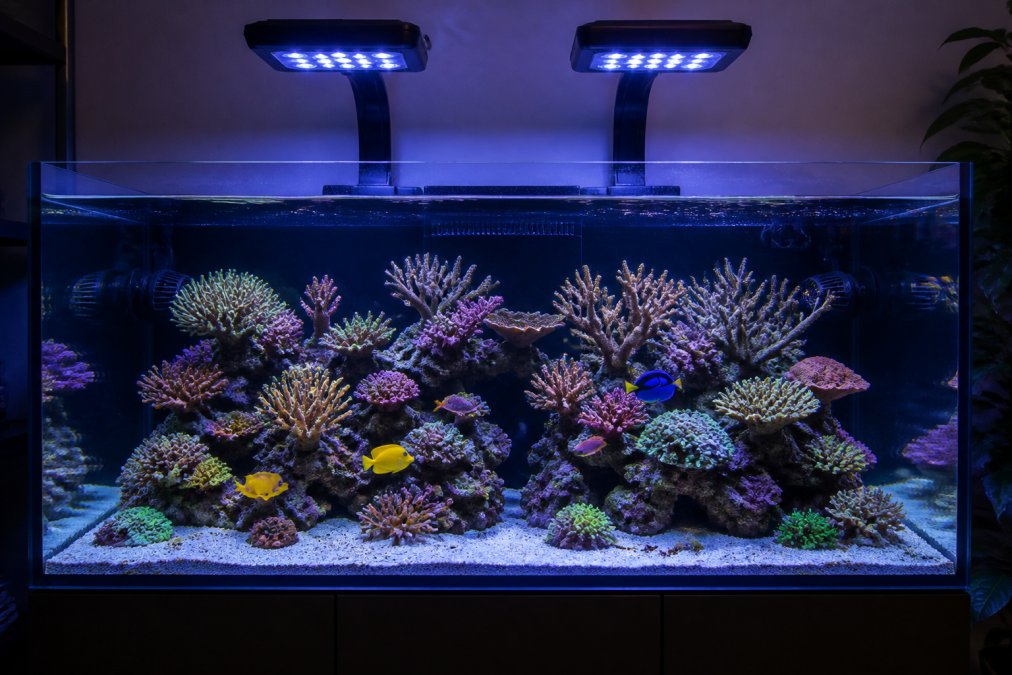
The Deluxe Edition includes two ReefLED 115 lights, a significant advantage over the base model. Dual lighting means even PAR distribution across the 36-inch length, preventing dead zones that create algae problems and coral bleaching (peer-reviewed research).
The all-in-one design is thoughtfully engineered. The 8-gallon sump sits beneath the display tank, hidden behind the cabinet. Quick-release fittings let you service the sump in under a minute. The dual return outlets create balanced flow that prevents dead spots.
At $3,400 for the Deluxe Edition (or $2,399 for the base 250 G3), you're investing in a system that grows with you. Most hobbyists stay with this tank for 3-5 years before upgrading. The ReefBeat App integration lets you adjust lighting schedules from your phone, set acclimation ramps for new corals, and trigger moonlight cycles without touching the cabinet.
Red Sea REEFER Deluxe 300 G3 and 350 G3: Best Mid-Size Reef Tanks
Once you've decided a 54-gallon system is too small, the 300 G3 (65 gallons) or 350 G3 (72 gallons) offer meaningful jumps in stocking capacity and water stability.
The 300 G3 sits at a sweet spot for mixed reef displays. The 12-millimeter ultra-clear glass handles the extra water weight without flex. The 12-gallon sump means longer intervals between water changes and more forgiving parameter swings. You can reasonably keep 30-40 fish and 50+ coral colonies without compromising water quality.
The 350 G3 is the professional's choice at this size tier. At 72 gallons and 42 inches long, it's the largest all-in-one Red Sea system before stepping into custom builds. The larger sump and dual return system handle more bioload. If you're planning an SPS-dominant display, this is your platform. Both models start at $3,600 and $3,800 respectively.
The real decision between the 300 and 350 comes down to space and ambition. The 300 fits most living rooms. The 350 requires wall-mounted placement or a dedicated stand. If you have the space and plan to run SPS corals, the 350's extra length and volume justify the cost.
Essential Equipment for Starting a Saltwater Tank
Protein Skimming removes dissolved organic compounds before they break down into ammonia and nitrate. For a 54-gallon system, undersizing is the most common beginner mistake. A skimmer rated for 100+ gallons gives you headroom and quieter operation. Budget $200-400 for a quality unit.
Return Pumps circulate water from the sump back to the display. The rule of thumb is 10-15 times the tank volume per hour (peer-reviewed research). A 54-gallon tank needs 540-810 gallons per hour of flow. Most all-in-one systems include adequate return pumps, but verify the specs before purchase.
Biological Filtration happens in the sump through live rock and bacterial colonization, converting ammonia to nitrite to nitrate. Budget 1-1.5 pounds of live rock per gallon of display volume. For a 54-gallon tank, that's 54-81 pounds.
LED Lighting like the Red Sea ReefLED 115 delivers full-spectrum output with minimal heat generation and app-controllability. A single ReefLED 115 costs around $400-500; dual setups run $800-1,000.
Water Testing equipment keeps you honest. You need a refractometer for salinity ($30-50), a quality pH probe ($80-150), and calcium/alkalinity test kits ($20-40 each). Skip cheap test strips, they're inaccurate.
Automatic Top-Off Systems like the Red Sea ReefATO+ ($225) handle evaporation while maintaining salinity. The ReefATO+ includes three sensors and app integration, so you know immediately if something goes wrong.
Heaters and Chillers maintain stable temperature between 76-78°F. A 300-watt heater handles most systems under 75 gallons. Chillers are expensive ($500+) but essential if your room temperature exceeds 80°F.
Blue Earth Corals and Aquariums stocks all this equipment and helps you select the right gear for your specific setup rather than overselling unnecessary upgrades.
Cost of Starting a Reef Aquarium: Budget Breakdown for 2026
The Tank System: $2,400-$3,800 depending on size. The Red Sea REEFER Deluxe 250 G3 at $3,400 represents the sweet spot for beginners.
Lighting: Included in most all-in-one systems, but budget $200-400 if you need to upgrade or add supplemental lights.
Circulation and Filtration: The return pump and skimmer add $300-600.
Live Rock and Substrate: Budget $200-400 for live rock and $50-150 for substrate.
Testing Equipment: $150-300 for a proper setup including refractometer, pH probe, and test kits.
Automation Equipment: A ReefATO+ system costs $225. A basic aquarium controller like the Neptune Systems A3 Apex Jr runs $329.99.
Live Corals and Fish: Budget $500-1,500 for your initial stocking. Quality matters more than quantity.
Maintenance Supplies: Salt mix, calcium, alkalinity supplements, and cleaning supplies run $100-200 for the first year, then $50-100 annually.
First-Year Total: $4,500-$8,000 depending on how aggressively you stock and which automation you add.
Spread across 12 months, that's $375-667 per month. The mistake most beginners make is buying cheap equipment upfront, then spending twice as much replacing it within a year.
Best Coral for Beginner Reef Tanks
Soft Corals like leather corals, mushrooms, and zoanthids tolerate moderate lighting and inconsistent feeding. They're colorful, grow quickly, and feel rewarding. Start here.
LPS Corals (Large Polyp Stony) like Euphyllia and Blastomussa sit in the middle ground. They need decent lighting and occasional feeding but are far more forgiving than SPS. They're also stunning with flowing tentacles and vibrant colors.
SPS Corals (Small Polyp Stony) like Acropora and Montipora demand high light intensity, pristine water chemistry, and strong flow. Skip these for your first year.
Avoid These Corals as a Beginner: Anemones (they move, eat fish, and require perfect conditions), Tridacna clams (beautiful but finicky), Goniopora (notoriously difficult), and Acropora (unless you're committed to SPS from the start).
Blue Earth Corals and Aquariums grows healthy LPS and soft corals in our West Palm Beach aquaculture facility. We can recommend specific species based on your lighting setup and guarantee healthy arrival.
How to Choose Your First Reef Tank: Key Considerations
Space Constraints Matter More Than You Think
A 33-gallon tank (24 inches long) fits on a bookshelf. A 54-gallon system needs a dedicated stand or wall mount. A 72-gallon tank requires serious real estate. Measure twice, buy once, accounting for equipment behind and beside the tank.
Water Chemistry Stability Wins Over Size
A 54-gallon tank with stable parameters beats a 120-gallon tank with fluctuating pH and alkalinity. All-in-one systems like the Red Sea REEFER series are engineered for stability regardless of size.
Lighting Determines What You Can Keep
The included ReefLED 115 lights handle soft corals and beginner LPS beautifully. If you want SPS, you need higher PAR output, which means more expensive lights and more heat generation.
Budget for Automation Early
A ReefATO+ ($225) and basic controller like the Neptune Systems A3 Apex Jr ($329.99) cost $555 total. They prevent catastrophic failures, evaporation crashes, and temperature swings that kill tanks and enthusiasm.
Plan Your Water Change Schedule
A 54-gallon system needs 10-15 gallons of water changed weekly. A 72-gallon system needs 15-20 gallons weekly. If you hate maintenance, buy a smaller tank.
Choose Between All-In-One and Custom
All-in-one systems like the Red Sea REEFER Deluxe 250 G3 are engineered for beginners. Everything is integrated and tested. Custom setups offer flexibility but require knowledge. Start with all-in-one.
Starting a reef tank is an investment in a living ecosystem that rewards patience and precision. The equipment you choose in the first month determines your success over the next five years. The Red Sea REEFER Deluxe systems represent the best balance of engineering, reliability, and beginner-friendliness available in 2026.
At Blue Earth Corals and Aquariums, we've helped hundreds of hobbyists set up their first reef tanks. We stock the complete Red Sea REEFER lineup, provide professional installation and setup guidance, and offer healthy, tank-raised corals and fish backed by our guarantee. Whether you're setting up a 33-gallon apartment display or a 72-gallon mixed reef, we'll help you build something worth maintaining. Shop now and start your reef journey with equipment and expertise you can trust.
Frequently Asked Questions
What size reef tank is best for a beginner?
A 40-65 gallon reef tank strikes the best balance for beginners. Tanks smaller than 30 gallons experience rapid water chemistry swings that stress corals and fish, while larger systems offer more stability. The Red Sea REEFER Deluxe 250 G3 (54 gallons) and 300 G3 (65 gallons) are ideal starter sizes, large enough to maintain stable parameters but manageable for daily maintenance and water changes.
Are all-in-one reef tanks better for beginners than custom setups?
Yes, all-in-one systems simplify setup and maintenance significantly. They come pre-plumbed with integrated sumps, return pumps, and overflow systems, eliminating the need to source and assemble separate components. All-in-one reef tanks also feature built-in biological filtration chambers and ReefMat-ready sumps for mechanical filtration. This reduces setup time from weeks to days and makes water chemistry management more straightforward for new hobbyists.
What is the total cost of starting a reef aquarium in 2026?
A complete beginner reef setup costs $3,500-$5,500. The tank itself (like the Red Sea REEFER Deluxe 250 G3 at $3,400) is the largest expense. Add $300-$600 for essential equipment including a protein skimmer, return pump, and lighting. Budget $500-$800 for live rock, substrate, and initial livestock. Additional costs include water testing equipment ($100-$200), RO/DI water system ($150-$300), and a maintenance supply buffer ($200-$300).
What essential equipment do I need to start a saltwater tank?
Core equipment includes a protein skimmer for mechanical and biological filtration, a return pump for water circulation, LED lighting optimized for coral growth, a refractometer for salinity measurement, a heater and thermometer, powerheads for flow, and an automatic top-off system like the Red Sea ReefATO+ ($225) to maintain stable water levels. Most all-in-one systems include the tank, sump, and plumbing, but you'll add the skimmer, lighting, and automation separately.
Which corals are easiest for beginners to keep alive?
Soft corals like mushrooms, leather corals, and zoanthids tolerate variable water chemistry and require minimal lighting compared to SPS (small polyp stony) corals. LPS (large polyp stony) corals such as torch corals, frogspawn, and hammer corals are also beginner-friendly, they're forgiving with placement and lighting but need moderate water flow. Start with soft and LPS varieties before attempting challenging SPS species, which demand precise calcium, alkalinity, and light parameters.
This article was written using GrandRanker
Best Reef Tank Supplements for Growth
Best Saltwater Fish for Beginners in 2026
Related Posts

How to Choose the Right Coral Lighting

SPS vs LPS Coral Care Requirements

Design a 75 Gallon Reef Tank: Complete Setup Guide

Coral Acclimation Guide for Hobbyists: 2026 Edition

Professional Reef Tank Installation Cost: 2026 Guide

How to Prevent Fish Disease Introduction: 7 Steps

Troubleshooting Common Reef Tank Problems: 2026 Guide
