

Why Is My Coral Losing Color: Causes and Recovery
Table of Contents
- Why Coral Loses Color: The Main Culprits
- Coral Bleaching Causes and Early Warning Signs
- Optimal Reef Tank Water Parameters for Coral Color
- Diagnostic Flowchart: Identifying the Root Cause
- How to Improve Coral Coloration: Recovery Protocols
- Filter Feeding and Nutritional Requirements
- When to Seek Professional Help
- Frequently Asked Questions
Last Updated: September 2, 2026
Why Coral Loses Color: The Main Culprits
When your coral starts fading, something in your tank has shifted. At Blue Earth Corals and Aquariums, most color loss is reversible if caught early.
The most common causes fall into three categories: insufficient light, nutrient imbalances, and stress from temperature or water chemistry changes. Light is the foundation of coral health, without adequate intensity and spectrum, corals can't photosynthesize effectively through their symbiotic zooxanthellae, leading to gradual fading.
Insufficient Light Intensity and Spectrum
Corals need more light than most hobbyists realize. Photosynthetically active radiation (PAR) is the measurement that matters. Most reef corals thrive between 150-250 PAR depending on species; soft corals and LPS can handle 75-150 PAR, but SPS corals demand the higher end (peer-reviewed research).
Spectrum matters equally. Corals evolved under sunlight containing the full visible spectrum. When lighting skews too heavily toward blue or lacks sufficient red wavelengths, the coral's pigment-producing cells don't receive the signal to maintain full coloration. Quality LED systems like Red Sea give you control over spectrum ratios. The photoperiod also affects color, most corals do best with 8-10 hours of light daily. Running lights 24/7 causes stress; fewer than 6 hours means insufficient energy production.
Nutrient Imbalances: Nitrates and Phosphates
Corals need nitrogen and phosphorus in balanced ratios. The ideal range for nitrate is 5-20 ppm, and phosphate should sit between 0.05-0.1 ppm (peer-reviewed research). When these get out of balance, corals lose the building blocks needed to produce vibrant pigments.
High nitrate without corresponding phosphate availability creates nutrient stress. Conversely, low nutrient levels from heavy protein skimming or aggressive water changes starve the coral of essential nutrients. Test your nutrients regularly and adjust through targeted dosing or by modifying feeding and water change frequency.
Coral Bleaching vs. Color Loss: What's the Difference?
Coral bleaching is the expulsion of zooxanthellae, the symbiotic algae living inside the coral's tissue. A bleached coral turns white or translucent. Color loss is when the coral retains its zooxanthellae but the pigment-producing cells reduce pigmentation. The coral stays opaque but fades to pale versions of its original colors.
Bleaching is more acute and dangerous. A fully bleached coral can recover if conditions improve quickly, but prolonged bleaching leads to tissue death. Color loss is slower and usually reversible, the coral is still feeding and photosynthesizing, just at reduced capacity. In home aquariums, true bleaching is usually triggered by temperature stress, extreme light changes, or chemical shock. Color loss is more often caused by chronic suboptimal conditions.
Coral Bleaching Causes and Early Warning Signs
Bleaching happens when a coral expels its zooxanthellae as a stress response to temperature spikes, lighting changes, or chemical swings.
Zooxanthellae Stress and Symbiotic Algae Loss
Zooxanthellae are dinoflagellates living inside the coral's endoderm that photosynthesize, passing sugars to the coral in exchange for a protected home. When stress hits, the coral can sever this relationship and expel the algae.
Temperature is the most common trigger. Most reef corals thrive between 76-78°F (peer-reviewed research). A sustained temperature above 82°F or below 74°F stresses the algae. Even a 2-degree sudden swing can trigger bleaching.
Light stress also causes zooxanthellae expulsion. If you upgrade your lighting and suddenly flood corals with 3x more PAR than they've experienced, the algae can't process the energy fast enough. Increase intensity gradually over 2-4 weeks, not overnight. Chemical stress, a sudden pH swing, ammonia spike, or pesticide contamination, triggers bleaching by damaging the algae directly. Early warning signs include subtle color shifts toward pale tones before full bleaching occurs.
Temperature Fluctuations and Acclimation Shock
Temperature stability is non-negotiable for coral health. Check your reef tank thermometer daily. Without monitoring, you might have a 4-5 degree swing between day and night.
Acclimation shock happens when you introduce a coral from a different environment without gradually adjusting it to your tank conditions. The standard acclimation process takes 1-2 weeks. Start by placing the coral in a low-light area of your tank. Gradually move it to its final location over several days, increasing light exposure incrementally. Float the coral in a bag within your tank for 15-20 minutes to let temperatures equalize before introducing it to the tank water.
Optimal Reef Tank Water Parameters for Coral Color
Coral coloration is directly tied to water chemistry. When your parameters are stable and optimal, corals express their full genetic potential for color.
Alkalinity, Calcium, and Magnesium Levels
These three parameters form the foundation of reef tank chemistry. Alkalinity should sit between 8-12 dKH. Calcium should be 400-450 ppm. Magnesium should be 1,200-1,350 ppm. These are the concentrations found in natural seawater, and corals evolved expecting these specific levels.
Alkalinity is the buffer that keeps pH stable. Without adequate alkalinity, pH swings wildly, stressing corals and reducing pigment expression. Calcium is the raw material for coral skeleton building and affects the coral's ability to regulate internal ion concentrations. Magnesium helps the coral absorb and use calcium. A tank with adequate calcium but low magnesium will still show stunted growth and poor coloration.
The key is stability. A parameter that's slightly off but consistent is less harmful than one that swings wildly. This is why consistent testing and gradual adjustments matter more than chasing perfect numbers.
Trace Elements and Minor Nutrients
Beyond major parameters, corals need trace elements: iodine, strontium, molybdenum, and others in smaller quantities. Their absence shows up as poor coloration and stunted growth.
Iodine is especially important for vibrant red and orange pigments. It supports the production of tyrosine, an amino acid involved in pigment synthesis. Strontium supports skeletal growth and pigment-producing pathways. Most hobbyists dose trace elements empirically using commercial supplements at recommended dosages. If your corals are losing color despite good light, stable temperature, and balanced major nutrients, trace element depletion is worth considering. A high-quality trace element supplement can restore pigmentation within 2-4 weeks.
Diagnostic Flowchart: Identifying the Root Cause
Pinpointing the exact cause of color loss requires systematic investigation.
Step 1: Check your lighting. Measure PAR at the coral's location. If it's below 100 PAR, insufficient light is likely your problem. If PAR is adequate (150+ for most corals), move to step 2.
Step 2: Test your water parameters. Run a complete test: temperature, pH, alkalinity, calcium, magnesium, nitrate, and phosphate. Compare results to optimal ranges. If any parameter is significantly out of range, that's your culprit. If all are in range, move to step 3.
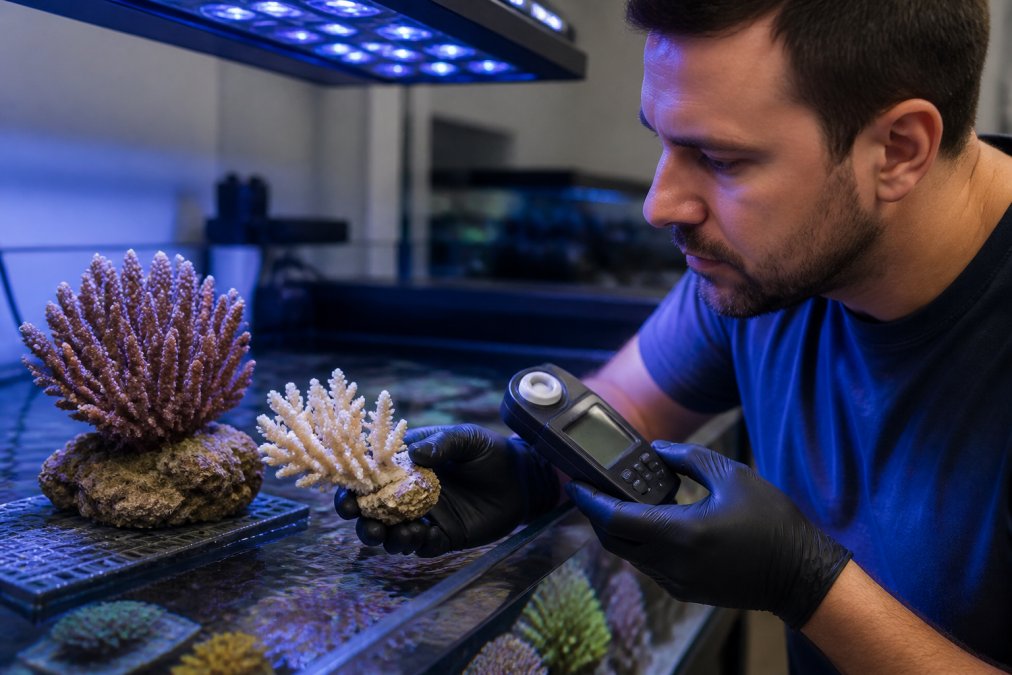
Step 3: Assess for bleaching signs. Is the coral white or translucent, or just pale? True bleaching indicates zooxanthellae loss, usually from temperature stress or light shock. Pale color with the coral still opaque suggests nutrient deficiency or chronic suboptimal conditions.
Step 4: Review recent changes. Did you upgrade lighting, change water change frequency, add new equipment, or adjust feeding? Recent changes often trigger color loss. Gradual loss over weeks or months with no recent changes suggests chronic parameter drift.
Step 5: Consider acclimation. If the coral is newly acquired and color loss started within days of introduction, acclimation shock is the likely cause.
This systematic approach eliminates guesswork and points you toward the actual fix.
How to Improve Coral Coloration: Recovery Protocols
Once you've identified the cause, recovery is straightforward. The coral wants to be healthy and colorful; you're just removing the obstacle.
Adjusting Light: PAR Ranges and Photoperiod
If light is your limiting factor, adjust gradually. If your current PAR is 80 and your target is 200, increase by 20-30 PAR every 3-4 days to give zooxanthellae time to upregulate their photosynthetic machinery.
The optimal photoperiod for most corals is 8-10 hours daily. If you've been running lights 12+ hours, reduce to 10 hours over a week. If fewer than 6 hours, increase to 8 hours. This adjustment alone can restore significant color within 2-3 weeks. If your current lighting is heavily blue-weighted, adding more red spectrum will enhance red and orange pigments.
Stabilizing Water Chemistry and Nutrient Export
If parameters are drifting, identify why. Common causes include inadequate water changes (increase to 25% weekly), overly aggressive protein skimming (dial back slightly), or feeding imbalances. The goal is achieving a balance where your major parameters stay within range without constant manual dosing. This typically takes 2-4 weeks of adjustment.
For trace elements, use a quality supplement dosed according to package directions. Dose consistently, daily or every other day, rather than trying to catch up with large doses.
Coral Dipping and Stress Management
Coral dipping involves briefly soaking the coral in a freshwater or medicated solution to remove parasites or algae. If you choose to dip, use a commercial coral dip product and follow manufacturer's instructions exactly, typically 30 seconds to 2 minutes. After dipping, acclimate the coral back to your tank water gradually over 10-15 minutes.
Stress management is more important than dipping. Minimize handling, avoid sudden parameter changes, and give newly acquired corals 1-2 weeks of reduced light before moving them to their final location.
Filter Feeding and Nutritional Requirements
Many reef keepers assume corals get all their nutrition from photosynthesis, but most corals are also filter feeders. They capture zooplankton, copepods, phytoplankton, and organic detritus. This heterotrophic feeding provides amino acids and proteins that support pigment production.
Corals that don't receive adequate particulate food often show reduced coloration even when light and water chemistry are perfect. To support filter feeding, reduce protein skimming slightly if excessive, or target-feed your corals directly using a turkey baster to gently squirt small food particles at the coral's polyps. Use phytoplankton, copepod cultures, or commercial coral foods. Feed 2-3 times per week in amounts small enough that the coral can consume them without excess drifting to the substrate.
When to Seek Professional Help
If you've worked through the diagnostic steps, made adjustments, and your corals aren't recovering color after 4-6 weeks, it's time to bring in a professional. At Blue Earth Corals and Aquariums, our team can perform a comprehensive tank evaluation, test parameters you might not be measuring, and identify issues difficult to spot without hands-on inspection.
Some problems require more than home testing can reveal. A persistent bacterial infection won't show up on a standard water test but will cause progressive color loss and tissue recession. Parasitic infestations are invisible to the naked eye but cause significant stress and color loss. Professional maintenance services can also help if your tank has drifted into a state difficult to recover from on your own.
Coral color loss is frustrating, but it's also diagnostic. Your corals are telling you something is wrong, and most causes are fixable. Start with the systematic approach: measure your light, test your water, check for recent changes, and adjust methodically. Most corals recover vibrant color within 2-4 weeks once the limiting factor is removed. If you're struggling to identify the cause or your corals aren't responding to adjustments, Blue Earth Corals and Aquariums offers professional consultation and maintenance services. Our team has 19+ years of experience diagnosing and resolving color loss in reef tanks of all sizes, and we're here to help you create the vibrant underwater ecosystem you envisioned.
Frequently Asked Questions
Q: What does a dying coral look like compared to one that's just losing color?
A: A coral losing color may appear pale or translucent but still shows polyp extension and feeding response. A dying coral exhibits tissue recession, no polyp movement, slime coating, or visible skeleton. Early color loss is reversible; tissue recession is a sign of advanced stress. Monitor for polyp behavior and water parameters to catch problems early.
Q: How do I know if my coral is experiencing coral bleaching causes or just needs better lighting?
A: Bleached corals turn white or very pale as zooxanthellae (symbiotic algae) expel from tissues. Color loss from poor lighting happens gradually and unevenly. Bleaching is often accompanied by stress indicators: rapid color change, mucus production, or tissue recession. Check your PAR levels (most corals need 150-400 μmol/m²/s), water temperature stability, and nutrient levels. If temperature and parameters are stable, lighting is likely the issue.
Q: Can my coral come back to life after losing color?
A: Yes, if caught early. Corals losing color due to lighting, nutrients, or acclimation stress often recover within 2-4 weeks once the cause is fixed. Adjust light intensity gradually, stabilize water parameters (alkalinity 8-12 dKH, calcium 400-450 ppm, magnesium 1250-1350 ppm), and ensure consistent photoperiod. Corals with active tissue recession need immediate intervention. Those that have fully bleached and show skeleton exposure are unlikely to recover.
Q: What's the fastest way to get corals to color up again?
A: Start with water parameter stability: test and adjust alkalinity, calcium, magnesium, and nitrate/phosphate balance. Increase light intensity gradually over 1-2 weeks to match your coral's species requirements. Add quality filter feeding (phytoplankton, zooplankton) 2-3 times weekly. Include trace elements like iodine and strontium. Avoid coral dipping unless tissue recession is visible. Most color recovery takes 3-6 weeks; patience and consistency matter more than quick fixes.
This article was written using GrandRanker
The Proper Steps for Introducing New Fish to Your Aquarium
Best Reef Tank Supplements for Growth
Related Posts

How to Choose the Right Coral Lighting

SPS vs LPS Coral Care Requirements

Design a 75 Gallon Reef Tank: Complete Setup Guide

Coral Acclimation Guide for Hobbyists: 2026 Edition

Professional Reef Tank Installation Cost: 2026 Guide

How to Prevent Fish Disease Introduction: 7 Steps

Troubleshooting Common Reef Tank Problems: 2026 Guide
