

Why Corals Die After Introduction: Prevention Guide
Table of Contents
- Why Corals Die After Introduction: The First 72 Hours Matter
- Understanding Coral Bleaching and Stress Response
- The Coral Acclimation Process: Drip Method vs. Floating
- How to Acclimate Corals to New Lighting Without Shock
- Water Parameters That Kill Corals on Arrival
- Coral Dip Best Practices for New Arrivals
- Signs of Coral Stress in Reef Tanks and Recovery Timeline
- Post-Introduction Quarantine and Pathogen Prevention
- Frequently Asked Questions
Last Updated: September 28, 2026
Why Corals Die After Introduction: The First 72 Hours Matter
When a new coral arrives at your tank, the first three days determine whether it thrives or fails. Most hobbyists don't realize that corals die after introduction not because the specimen is weak, but because the transition process is handled wrong. The shock of moving from one water chemistry to another, different salinity, temperature, lighting, and nutrient levels, triggers a stress response that weakens the coral's symbiotic relationship with zooxanthellae.
The common thread in failures is often the same: rushed acclimation or skipped quarantine steps. The good news is this is entirely preventable.
Here's what separates a coral that arrives and immediately starts coloring up from one that bleaches within a week. The difference comes down to understanding osmotic shock, light acclimation, and water parameter matching. Below, we'll walk you through exactly how to prevent coral death and set new arrivals up for long-term success.
Understanding Coral Bleaching and Stress Response
Coral bleaching happens when zooxanthellae, the algae living inside coral tissue that provide nutrition and color, abandon the coral under stress. This isn't a disease. It's a survival response. When conditions change too fast, the coral's symbiosis breaks down.
Temperature swings, sudden light changes, and salinity mismatches all trigger this response. The coral expels its algae partners and turns white or pale. Without zooxanthellae, the coral cannot feed itself and will starve within days.
Understanding this mechanism matters because it changes how you handle new arrivals. You're not just acclimating a coral to water, you're protecting a living partnership between two organisms.
The Coral Acclimation Process: Drip Method vs. Floating
The two main acclimation approaches are the drip method and floating. One works significantly better.
The floating method is what most beginners use. You float the shipping bag in your tank for 15-20 minutes to equalize temperature, then dump the coral into the display. This is dangerous. The coral goes from one chemistry to another in minutes. Osmotic shock hits hard.
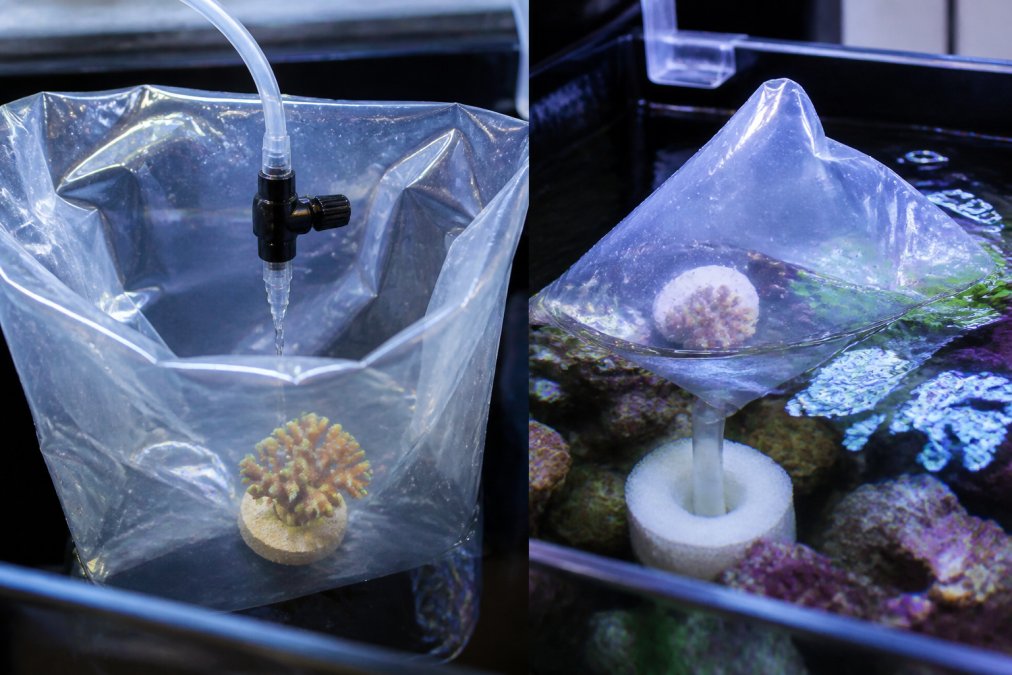
The drip method uses gravity to slowly replace the shipping water with your tank water over 30-60 minutes. The coral's chemistry adjusts gradually. This is the professional standard for good reason.
Why Drip Acclimation Works Better
The drip method succeeds because it mimics natural water mixing. A coral doesn't encounter a wall of new chemistry. Instead, it experiences a gradual transition that its regulatory systems can handle.
The process takes time, but time is the investment that prevents death. Thirty minutes of drip acclimation costs nothing except patience. Losing a $100+ coral costs money and frustration.
The IceCap Acclimation Kit ($10.50) handles this for you. It includes a manual siphon starter, flow control valve, and foam strainer that prevents debris from clogging the line. No sucking on tubes, no guessing at flow rate. Just clip it over your tank rim and let gravity work.

Common Mistakes During Acclimation
Mistake 1: Acclimating for too long. More than 60 minutes doesn't help. The shipping water becomes stagnant. Ammonia and nitrate spike. Stop at 45-60 minutes.
Mistake 2: Dripping too fast. A fast drip means the coral isn't actually acclimating. Aim for one drop every 2-3 seconds. If water is pouring, slow it down.
Mistake 3: Mixing shipping water back into the tank. Never do this. The shipping water contains ammonia and waste. Discard it. The coral only needs the tank water to adjust to, not the old water mixed in.
Mistake 4: Skipping the float step. Float the bag for 5-10 minutes first to equalize temperature. Then drip acclimate. Temperature shock alone can kill a coral.
How to Acclimate Corals to New Lighting Without Shock
Light shock is one of the biggest killers of newly introduced corals. Many corals arrive from farms or wholesalers running lower light than your display. Moving a coral from 200 PAR to 400 PAR overnight causes immediate stress and bleaching.
The fix is gradual light exposure. Start the coral in a low-light area of your tank for the first week. Then move it progressively toward the final spot over 7-10 days.
PAR (photosynthetically active radiation) is the measurement that matters. If you don't have a PAR meter, use position as a proxy. Place new corals lower in the tank or toward the back where light is dimmer. Move them forward and up as they recover color.
Watch for signs of stress during this transition. If a coral starts bleaching even in low light, it's responding to other stressors, likely water parameters. Fix those first before worrying about lighting.
Most corals need specific PAR levels for SPS (small-polyp stony) and LPS (large-polyp stony). But newly introduced corals need less initially. Give them time to adjust their zooxanthellae density before exposing them to full intensity.
Water Parameters That Kill Corals on Arrival
New corals die most often from water parameter mismatch, not from disease or poor genetics. Three parameters matter most: salinity, alkalinity, and nutrient levels.
Salinity, Alkalinity, and Osmotic Shock
Salinity is the total dissolved salt content. It's measured in specific gravity (SG) or parts per thousand (PPT). Most coral farms run 1.025-1.026 SG. Most display tanks run the same. But small differences cause osmotic shock.
Osmotic shock happens when the coral's internal salt concentration differs from the surrounding water. Water moves in or out of the coral's cells trying to balance the difference. This ruptures cell membranes and kills tissue.
The drip acclimation method prevents this by letting the coral's cells adjust gradually. But you also need to check your actual salinity. Many hobbyists think their tank is 1.025 but it might be different. A significant gap can stress corals.
Use a refractometer, not a hydrometer. Hydrometers are notoriously inaccurate. A refractometer costs more but gives reliable readings. Aim for 1.025-1.026 SG. Stay within 0.001 of that target.
Alkalinity (also called dKH or carbonate hardness) is the buffer capacity of your water. It keeps pH stable. Corals need alkalinity to build their skeletons. Low alkalinity means corals can't calcify. They stop growing and slowly decline.
New corals often arrive in water with different alkalinity than your tank. If your tank runs 8 dKH and the shipping water was 6 dKH, the coral experiences a chemical shift. The drip method handles this, but you should also check your alkalinity.
Target 8-9 dKH for most reef tanks. Test it regularly. If it drops, consider dosing a calcium and alkalinity supplement.
Calcium, Magnesium, and Nutrient Toxicity
Calcium and magnesium are less obvious killers but equally important. Corals need both to build skeleton and maintain cell function. But excess nutrients, especially phosphate and nitrate, cause algae blooms that outcompete corals for light and space.
Many wholesalers run higher nutrient levels than display tanks.
Coral Dip Best Practices for New Arrivals
A coral dip is a medicated bath that kills parasites and bacteria on the coral's surface. It's optional but recommended for wild-caught corals. Aquacultured corals (like those from Blue Earth Corals and Aquariums) are raised in controlled environments, so dipping may be less critical.
Signs of Coral Stress in Reef Tanks and Recovery Timeline
Stressed corals show clear warning signs. Catch them early and recovery is possible.
Early signs (first 24-48 hours):
- Polyps not extending or extending weakly
- Pale or washed-out color
- Visible mucus slime on tissue
- Retracted tentacles or zooids
Danger signs (48-72 hours):
- White tissue (bleaching)
- Brown jelly slime (bacterial infection)
- Tissue recession from the skeleton
- Complete polyp closure
Recovery timeline for a stressed coral that survives:
- Days 1-3: Polyps begin extending cautiously
- Days 4-7: Color starts returning
- Days 7-14: Full polyp extension returns
- Days 14-30: Growth resumes
Post-Introduction Quarantine and Pathogen Prevention
Quarantine is the step most hobbyists skip. It's also the step that prevents tank-wide disease outbreaks.
Watch for:
- Rapid tissue loss or recession
- Unusual color changes that don't improve
- Visible parasites (small white dots, moving spots)
- Algae growth on the coral
- Brown jelly or slime
Frequently Asked Questions
How long should I acclimate new corals to prevent shock?
Proper acclimation takes 30 to 60 minutes using a drip method. During this time, your display tank's water gradually replaces the shipping water, allowing the coral's tissues to adjust to your salinity, pH, and temperature without osmotic shock. Use a drip acclimation kit like the IceCap Acclimation Kit ($10.50) to control flow rate precisely. Rushing this process, even by 10 minutes, increases stress and tissue necrosis risk significantly.
What is the most common cause of coral death in a new tank?
Salinity mismatch and improper acclimation are common causes of coral death. Corals depend on stable osmotic conditions; differences in specific gravity can trigger stress. Combined with inadequate photoperiod adjustment and unstable alkalinity, new corals can experience tissue necrosis. Testing your water parameters with accurate tools, such as the Marine Magnesium Colorimeter HI783, ensures you catch imbalances before introducing corals.
How can I tell if my new coral is dying or just stressed?
Stressed corals retract polyps, lose color slightly, or produce excess mucus but remain intact. Dying corals show rapid tissue recession, visible skeleton exposure, or complete polyp closure lasting more than 6 hours. If you see these signs within the first 24 hours, consider moving the coral to a lower-light quarantine area, performing a water change, and checking your alkalinity and calcium levels immediately. Many stressed corals recover within a few days with stable conditions.
Why does light intensity affect coral survival after introduction?
Corals rely on their zooxanthellae symbiosis to produce energy through photosynthesis. Sudden exposure to high PAR (photosynthetically active radiation) triggers light shock, damaging the symbiotic algae and causing bleaching. New corals should be introduced to light gradually. This gradual photoperiod adjustment allows zooxanthellae to acclimate and helps prevent respiration stress from overwhelming the coral's recovery.
Living Art Aquariums vs Corals.com: Which Fits Your Reef?
How to Improve Coral Health: A Reef Tank Guide
Related Posts

Coral Fragging for Beginners: Step-by-Step Guide

How to Improve Coral Health: A Reef Tank Guide

Living Art Aquariums vs Corals.com: Which Fits Your Reef?

Reef Tank Design for Small Spaces: A How-To Guide

Stable Reef Water Parameters: A 2026 How-To Guide

Avoiding Coral Shipping Damage: 7 Proven Tips
