

Living Art Aquariums vs Corals.com: Which Fits Your Reef?
Table of Contents
- Quick Comparison: Service Models and Core Offerings
- Coral Frag Shipping Best Practices and Handling Standards
- Aquarium Design and Installation Costs: Service vs. DIY
- Livestock Health and Specimen Quality Standards
- Where Can I Buy Pet Fish Near Me: Local vs. Online Options
- Pricing Breakdown and Total Cost of Ownership
- Making Your Choice: Which Retailer Serves Your Setup Best
- Frequently Asked Questions
Last Updated: September 27, 2026
Quick Comparison: Service Models and Core Offerings
Choosing between a full-service aquarium provider and an online coral retailer depends on one question: do you want professional installation and maintenance, or do you prefer total control? This shapes cost, convenience, and success rates.
Blue Earth Corals and Aquariums operates as a hybrid model, offering both professional installation and maintenance services plus an online catalog for direct purchases. You can buy frags online and acclimate them yourself, or let our team design and maintain your entire system.
| Service Model | Professional Installation | Online Coral Sales | Maintenance Plans | Best For |
|---|---|---|---|---|
| Full-service provider | Yes | Limited | Yes | Hands-off hobbyists, custom builds |
| Online retailer | No | Yes | No | DIY keepers, frag collectors |
| Hybrid model | Yes | Yes | Yes | Flexible hobbyists, all experience levels |
Coral Frag Shipping Best Practices and Handling Standards
When corals arrive, the first 48 hours determine success. Shipping logistics matter, but acclimation protocol matters more.
Shipping Standards Across Retailers
Most reputable retailers use overnight shipping, with corals double- or triple-bagged and insulated.
The real difference isn't shipping speed, it's acclimation guidance. Fast shipping paired with zero post-arrival instructions sets you up for failure. Corals must transition slowly to your tank's specific conditions.
Acclimation Protocol: The Critical Step Most Retailers Overlook
Parameter Sensitivity by Coral Type
-
SPS corals (acros, milleporas, stylophora, montipora): Most sensitive. Require stable salinity (1.025-1.026), alkalinity (8.5-9.5 dKH), calcium (420-450 ppm), and strong flow. Acclimate for 90-120 minutes.
-
LPS corals (euphyllias, torch, brain, frogspawn): Moderately sensitive. Tolerate wider parameter ranges. Acclimate for 45-90 minutes.
-
Soft corals and zoanthids (zoanthus, palythoa, sinularia, leather corals): Most resilient. Acclimate in 30-45 minutes. Excellent for beginners.
Common Acclimation Mistakes
- Rushing the process: A coral that looks healthy during acclimation may crash 24 hours later if parameters weren't properly equalized.
- Mixing acclimation water: Pouring the mixture back into your tank reintroduces the coral's shipping water into your system.
- Immediate full lighting: Placing a freshly acclimated coral under full lighting causes post-acclimation bleaching.
- Ignoring tank parameters: Acclimate a coral to parameters that match your tank's baseline, not arbitrary targets.
What to Ask Retailers About Their Acclimation Support
Before ordering, ask whether retailers provide acclimation instructions with each shipment and specify times by coral type. Retailers that provide detailed, species-specific guidance understand post-shipping care, a strong indicator of livestock quality and customer support.
Aquarium Design and Installation Costs: Service vs. DIY
Professional installation typically costs $2,000 to $15,000+ depending on tank size, cabinetry, and equipment. You're paying for design, equipment selection, installation labor, and initial aquascaping. Blue Earth Corals and Aquariums offers custom design and installation for residential and commercial tanks.
DIY with online ordering is substantially cheaper upfront. A pre-built system like the Red Sea REEFER MAX Peninsula 500 G3 costs $7,499, plus corals and setup. The learning curve is real, but many hobbyists prefer control over every decision.

The hidden cost of DIY is time and mistakes. Poorly designed systems waste money on incompatible equipment. Incorrect parameters kill expensive corals. Equipment failures happen faster in hastily assembled tanks. By the time you've replaced dead livestock and upgraded failing equipment, you may have spent nearly as much as professional installation.
Livestock Health and Specimen Quality Standards
Specimen quality varies wildly across suppliers. You can't always tell from photos.
Blue Earth Corals and Aquariums maintains strict tank parameters: salinity 1.025-1.026, temperature 78°F, alkalinity 8.5 dKH, calcium 440 ppm, magnesium 1350 ppm, nitrate under 10 ppm, and phosphate under 0.05 ppm. Every coral includes WYSIWYG (What You See Is What You Get) or non-WYSIWYG designation.
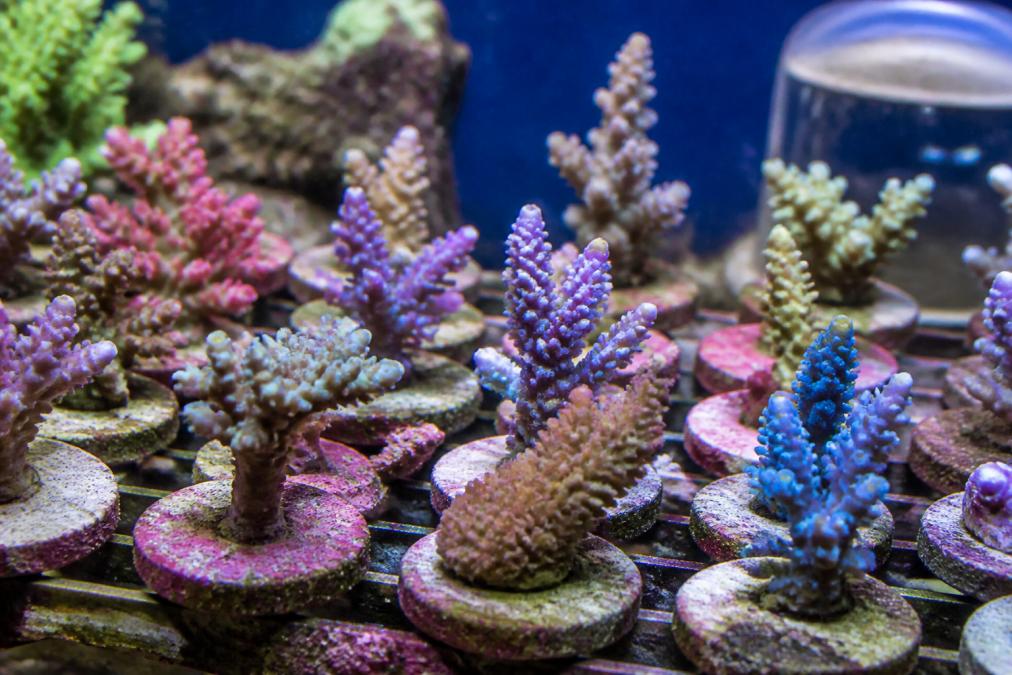
Most online retailers maintain similar standards, but verification is harder. When you can't see the conditions a coral was grown in, you're gambling on health. Ask any retailer for their tank parameters before buying. If they won't provide them, that's a red flag.
Where Can I Buy Pet Fish Near Me: Local vs. Online Options
The question "where can I buy pet fish near me" has two answers: local aquarium shops and online retailers.
Local shops let you see livestock in person, get immediate advice, and support your community. The downside: limited selection, higher prices, and variable expertise.
Online retailers offer massive selection, competitive pricing, and research capability. The tradeoff: you can't inspect livestock before purchase, shipping adds time and risk, and customer service happens remotely.
Blue Earth Corals and Aquariums bridges this gap. In our service area around West Palm Beach, you get both professional consultation and local service. Outside our area, you can order online with the same livestock quality and shipping standards. We're an actual aquaculture facility, not just a warehouse.
For customers far from professional services, online is often the only option. For those nearby, a hybrid approach, buying online for selection and price, using local services for installation and maintenance, offers the best of both worlds.
Red Sea REEFER MAX Peninsula 500 G3 →
Pricing Breakdown and Total Cost of Ownership
Building and maintaining a reef tank is expensive. Understanding total cost of ownership, not just upfront price, is critical.
Upfront System Costs: DIY vs. Professional
A single beginner coral frag runs $49.99 to $89.99.
DIY Build Upfront Cost Breakdown:
- Tank and stand: $1,500-$7,500
- Lighting: $400-$2,000
- Filtration: $800-$2,500
- Heater, chiller, auto top-off: $300-$1,000
- Testing equipment: $150-$400
- Live rock and substrate: $200-$800
- Initial livestock: $2,250-$5,000
- Salt, supplements, food (first 6 months): $300-$600
Ongoing Maintenance Costs: Where DIY and Professional Diverge
DIY Maintenance Costs (Monthly):
- Salt mix: $30-$60
- Supplements: $40-$100
- Food: $20-$50
- Testing supplies: $15-$30
- Equipment replacement (averaged annually): $50-$150
- Electricity: $30-$80
Total DIY monthly: $185-$470, averaging $300-$350.
Professional Maintenance Service Plans (Monthly):
- Standard plan (weekly water changes, parameter testing): $200-$350
- Premium plan (bi-weekly visits, coral feeding): $350-$500
- Concierge plan (weekly visits, emergency response): $500-$800+
Hidden Costs and Failure Modes in DIY Systems
Equipment failures and livestock losses compound costs:
Equipment failures:
- Protein skimmer: $400-$1,500
- Pump failure: $200-$800
- Heater or chiller: $150-$600
- Lighting fixture: $300-$2,000
Livestock losses due to parameter swings:
- Single SPS coral loss: $100-$500
- Full tank crash: $3,000-$10,000+ in livestock loss
- Disease outbreak: $500-$2,000
Realistic Five-Year TCO Comparison
DIY Scenario (mid-range hobbyist):
- Upfront: $10,000
- Monthly maintenance: $300 × 60 = $18,000
- Equipment failures: $2,000-$3,000
- Livestock losses: $2,000-$3,000
- Five-year total: $32,000-$34,000
- Plus: 200-400 hours of your time
Professional Installation + Mid-Tier Service Plan:
- Upfront: $17,000
- Monthly maintenance: $350 × 60 = $21,000
- Equipment failures (covered): $0-$500
- Livestock losses (minimal): $0-$500
- Five-year total: $38,500-$39,000
- Plus: 10-20 hours of your time
The Paradox: DIY Isn't Always Cheaper
When DIY Makes Financial Sense:
- You have 5+ years of reef-keeping experience
- You're willing to invest in redundancy
- You have time for daily monitoring
- You're comfortable with livestock loss risk
- You're building a small system (under 75 gallons)
When Professional Installation Makes Financial Sense:
- You're new to the hobby
- You have limited time for maintenance
- You're building a large or complex system (150+ gallons)
- You want peace of mind and emergency response
- You value your time at $25+ per hour
Making Your Choice: Which Retailer Serves Your Setup Best
If you're experienced, confident in setup skills, and want maximum selection and competitive pricing, an online retailer works fine. You'll save money and access rare frags.
Consider your situation:
- You have a 2-year-old reef tank and want specific frags: online retailer offers best selection and price
- You're starting your first reef tank: professional installation saves you from expensive mistakes
- You live in or near a service area: a provider offering both services lets you choose based on current needs
- You want rare collector pieces with confidence: buy from a retailer that publishes tank parameters and offers live arrival guarantees
Frequently Asked Questions
What's the difference between professional aquarium design services and online coral retailers?
Professional aquarium design services handle custom tank layout, equipment selection, water parameter management, and ongoing maintenance, typically for established systems or new builds. Online coral retailers focus on livestock sales, shipping individual corals, and basic care guidance. Professional services work best for complex installations or premium displays; online retailers suit hobbyists who already have stable systems and want specific coral frags or species.
How do I ensure the health of corals purchased online through proper acclimation?
Acclimation protocols matter most upon arrival. Monitor water parameters (salinity 1.025-1.026, alkalinity 8.5 dKH, calcium 440 ppm) and keep nitrate under 10 ppm for the first week. Most retailers, including those offering WYSIWYG corals, guarantee live arrival.
Are professional aquarium maintenance services worth the investment?
Professional maintenance services add value if you lack time, expertise, or confidence managing water chemistry, filtration, and livestock health long-term. Services typically cover parameter testing, water changes, equipment checks, and algae control, costs vary by tank size and frequency. DIY hobbyists save money but invest significant time. The choice depends on your schedule, tank complexity, and how much you value having an expert oversee your system.
What factors should I consider when choosing a coral vendor for rare or collector pieces?
Evaluate specimen quality (WYSIWYG photos show exact pieces), shipping logistics (overnight delivery, insulation, live arrival guarantees), water parameter documentation (vendor tank conditions should match your target setup), acclimation support, and DOA policies. Check for tank-raised or aquacultured corals to ensure biosecurity and avoid wild-caught stress. Rare collector pieces benefit from vendors with established aquaculture facilities, documented care protocols, and willingness to discuss specific lighting and flow requirements before purchase.
Reef Tank Design for Small Spaces: A How-To Guide
Why Corals Die After Introduction: Prevention Guide
Related Posts

Coral Fragging for Beginners: Step-by-Step Guide

How to Improve Coral Health: A Reef Tank Guide

Why Corals Die After Introduction: Prevention Guide

Reef Tank Design for Small Spaces: A How-To Guide

Stable Reef Water Parameters: A 2026 How-To Guide

Avoiding Coral Shipping Damage: 7 Proven Tips
