

How to Design Reef Ecosystems: A 2026 Guide
Table of Contents
- Planning Reef Zones and System Architecture
- Best Equipment for Starting Saltwater Tanks
- Reef Tank Aquascaping Techniques for Natural Structure
- Water Chemistry and the Nitrogen Cycle
- Building Biodiversity: Micro-Fauna and Ecosystem Succession
- Reef Tank Maintenance Schedule for Long-Term Stability
- Troubleshooting Ecosystem Imbalances Before They Crash Your Tank
- Conclusion
- Frequently Asked Questions
Last Updated: September 22, 2026
Planning Reef Zones and System Architecture
Learning how to design reef ecosystems starts with one idea most setup guides skip: you are building a biological system, not arranging equipment, and reef ecosystems reward that mindset. Blue Earth Corals and Aquariums has 19+ years of experience watching tanks succeed or fail on this distinction. A reef ecosystem is a self-regulating marine environment where live rock, sand, microbes, corals, and fish cycle nutrients together. Map your zones before you buy a single pump.
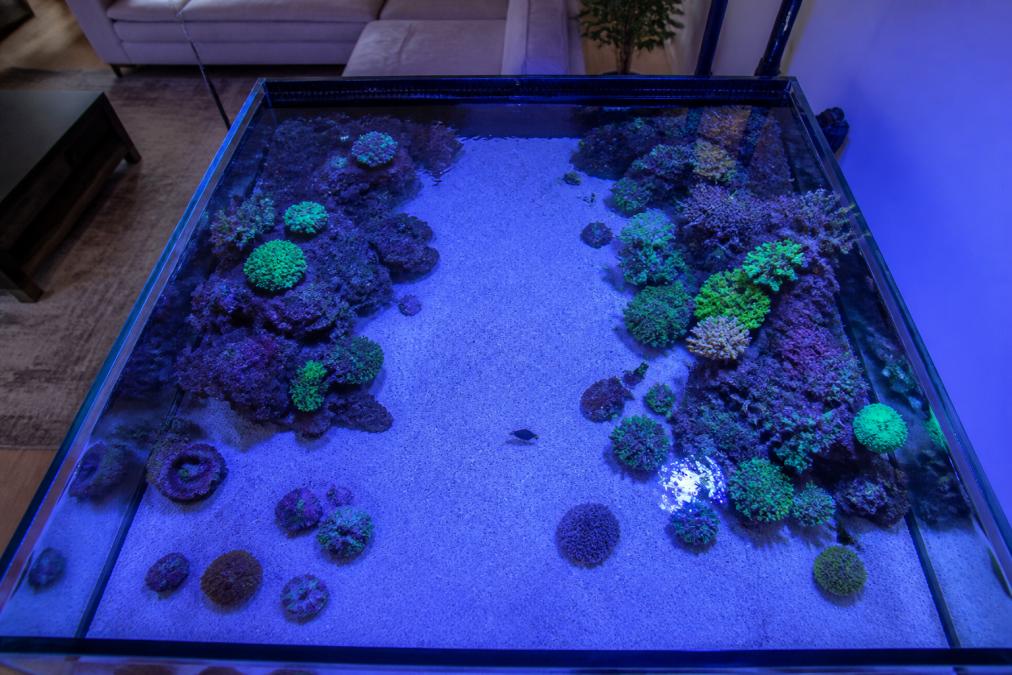
Mapping the Four Reef Zones in Your Tank
Think of your display as four distinct reef zones, each with its own flow, light, and stocking rules:
- Lagoon zone: low flow, moderate light, soft corals and sand-dwelling species
- Reef crest: high flow, intense light, SPS corals and calcifying organisms
- Fore reef slope: medium flow, moderate light, LPS corals and gorgonians
- Drop-off: shaded overhangs and ledges for non-photosynthetic species
Best Equipment for Starting Saltwater Tanks
The best equipment for starting saltwater tanks is the gear that keeps the biological system stable with the least daily intervention. Prioritize filtration, flow, and lighting in that order, because water quality problems crash more tanks than poor lighting ever will. Equipment is not the ecosystem, it is the life-support scaffolding that buys your microbes, corals, and fish the stable conditions they need to do the real work.
Filtration: Mechanical, Biological, and Chemical Stages
A complete filtration system layers three jobs. Mechanical filtration traps particulate waste before it decays. Biological filtration hosts the nitrifying bacteria that convert ammonia to nitrite to nitrate. Chemical filtration (activated carbon, GFO) pulls dissolved organics and phosphate that biology cannot process fast enough.
Flow: Turbulent, Random, and Sized to the Tank
Corals evolved in moving water. Flow delivers food, sweeps waste off tissue, and drives gas exchange. Aim for turbulent, random patterns rather than a single directional jet, a single powerhead pointed one way creates dead spots behind rock and laminar flow that stresses corals.
Lighting: PAR, Spectrum, and Photoperiod
Lighting should deliver appropriate PAR (photosynthetically available radiation) for your chosen corals, not maximum output. Soft corals and LPS generally thrive at 50-150 PAR; SPS typically want 200-350 PAR at their placement height. A PAR meter rental or a local club loaner is worth more than any marketing spec sheet.
Plug-and-Play Systems and What They Solve
Plug-and-play systems remove most of the sizing guesswork. The Red Sea REEFER 425 G3 Aquarium System includes a ReefMat-ready sump, silent downflow with a precision gate valve, and dual return outlets for balanced circulation. The REEFER 350 G3 pairs a ReefATO+ auto top-off with a ReefRun 5500 DC return pump, and the larger REEFER MAX 750 G3 ships with three ReefLED 170 lights, a ReefMat 1200 fleece roller, and ReefBeat App control for lighting, flow, and filtration cycles.

Reef Tank Aquascaping Techniques for Natural Structure
Good aquascaping techniques build structure first and decoration second. Real reefs are not rock piles; they are frameworks with overhangs, ledges, caves, and open water where fish swim and currents move.
Here is a simple build sequence:
- Place base rock directly on the tank floor, not on sand
- Stack upward with the largest pieces lowest
- Add ledges and overhangs facing your main light source
- Leave gaps for flow and fish movement
- Attach coral polyps only after the structure is stable
Water Chemistry and the Nitrogen Cycle
The nitrogen cycle converts toxic ammonia into nitrite and then into relatively harmless nitrate, and it is the foundation of marine chemistry in any reef tank. Beneficial bacteria in live rock, substrate, and your filtration system do this work continuously.
- Alkalinity: the buffer that supports calcification
- Calcium and magnesium: the building blocks of coral skeletons
- Salinity and temperature: the baseline for everything else
- Nitrate and phosphate: the fuel for nuisance algae when they climb
Building Biodiversity: Micro-Fauna and Ecosystem Succession
A reef tank matures in stages, and the organisms that appear along the way are doing real work. This is the part most guides ignore: your tank has a succession timeline, and fighting it slows everything down.
Reef Tank Maintenance Schedule for Long-Term Stability
A reef tank maintenance schedule works best when it is boring and repeatable. Stability comes from doing the same small tasks on the same rhythm, not from heroic rescues.
Red Sea REEFER MAX 750 G3 Aquarium →
| Task | Frequency | Why It Matters |
|---|---|---|
| Test alkalinity, calcium, salinity | 2-3x weekly | Catches drift before corals react |
| Clean skimmer cup and glass | Weekly | Maintains nutrient export and light penetration |
| Change filter media, check pumps | Monthly | Prevents flow loss and nitrate buildup |
| Water change (10-20%) | Every 2-4 weeks | Replenishes trace elements |
| Inspect corals and fish | Daily, quick look | Spots pests and disease early |
Troubleshooting Ecosystem Imbalances Before They Crash Your Tank
Most crashes announce themselves weeks in advance, and the warning signs are usually subtle. What most guides lack is a diagnostic framework, an ordered way to read the tank so you change the right variable instead of guessing. Treat every imbalance as a signal that one of four ecosystem functions has slipped: nutrient import, nutrient export, biological filtration, or physical stability.
The Four-Function Diagnostic Framework
Before you dose, dose nothing. Walk through these four functions in order and write down what you observe:
- Import, What is going in? Food volume, fish count, additive dosing, top-off water quality. Overfeeding is the most common hidden import problem; a pinch of frozen food can carry more phosphate than a week of coral feeding.
- Export, What is coming out? Skimmer production, refugium harvest weight, water change volume, filter media age. If skimmate is thin and pale, the skimmer is underperforming or the tank has low dissolved organics, not necessarily a problem, but a data point.
- Biological filtration, Is the microbial population healthy? Sudden ammonia or nitrite readings in a mature tank usually mean something died, medication was added, or live rock was disturbed. A tank that has been running for a year should not cycle again.
- Physical stability, Temperature swings, salinity drift from a failed auto top-off, alkalinity swings from a clogged dosing line. These are mechanical failures that present as biological symptoms.
Reading Common Imbalances by Symptom
Rising nitrate with slow coral growth. Export is losing to import. Check skimmer tuning, refugium harvest frequency, and water change volume before adding a carbon-dosing product. A refugium that has not been harvested in a month is not exporting, it is just growing.
The One-Variable Rule
Change one variable at a time and wait at least 3-7 days before judging the result. Multiple simultaneous adjustments make it impossible to know what worked, and they can stack into a new problem. Log every change with a date and a reading so patterns emerge from data rather than memory.
Conclusion
Designing a reef ecosystem that thrives for years takes planning, patience, and a system built for stability from day one. Blue Earth Corals and Aquariums supplies healthy live corals and saltwater fish from our West Palm Beach aquaculture facility, along with Red Sea systems like the REEFER 170 G3 and REEFER MAX 750 G3 that arrive plug-and-play ready. Our team also handles custom design, installation, and ongoing maintenance for residential and commercial tanks.
Frequently Asked Questions
What is the golden rule of aquascaping for reef tanks?
The golden rule is to build from the bottom up with a stable base. Place live rock directly on the tank bottom, not on substrate, so burrowing fish and invertebrates cannot cause collapses. Aim for roughly one-third open space, one-third rock structure, and one-third coral growth zones. Create overhangs, ledges, and caves to mimic natural reef topography. This arrangement gives fish territories, provides coral placement options at different light and flow levels, and supports the microbial filtration that keeps your reef ecosystems stable long-term.
What is the best flow pattern for a healthy reef ecosystem?
There is no single best pattern, but random, chaotic flow beats laminar flow every time. Use multiple powerheads on a controller to alternate directions and create turbulence. Aim for 20 to 40 times your tank volume in gallons per hour for mixed reefs, and higher for SPS-dominated systems. Alternate flow patterns prevent dead spots where detritus accumulates, deliver nutrients to coral polyps, and carry waste to your overflow and protein skimmer. Adjust flow based on coral placement: stronger flow near the top for SPS, gentler zones near the sandbed for LPS and soft corals.
How does lighting impact the design of a reef ecosystem?
Lighting determines which corals you can keep and where you place them. Photosynthetic corals rely on zooxanthellae, the symbiotic algae inside their tissue, to produce food through photosynthesis. Different species need different PAR levels and lighting spectrums. SPS corals typically need 250 to 400 PAR, while many LPS and soft corals thrive at 50 to 150 PAR. Design your aquascape with distinct light zones: place high-light corals on upper rockwork directly under fixtures and shade-tolerant species on the sandbed or under overhangs. LED fixtures with programmable spectrums let you adjust intensity and color temperature as your reef matures.
How do you choose compatible fish and corals for a reef system?
Start by understanding bioload. Every fish adds waste that your nitrogen cycle must process. Stock slowly, adding one or two fish at a time with weeks between additions. Research each species for aggression, adult size, and dietary needs. Avoid known coral-eaters like certain angelfish and butterflyfish in a mixed reef. For corals, group species with similar water parameter requirements and lighting needs. Quarantine all new livestock before adding them to your display tank. A 75-gallon system might comfortably house six to eight small to medium fish alongside a diverse coral collection, but the exact number depends on your filtration capacity and husbandry routine.
How do you create a stable ecosystem in a home reef aquarium?
Stability comes from consistent water parameters, adequate nutrient export, and a mature biological filter. Keep alkalinity between 7 and 9 dKH, calcium at 400 to 450 ppm, and magnesium at 1300 to 1400 ppm. Test regularly and adjust slowly. Use a protein skimmer, refugium, and regular water changes to export nutrients. Avoid large swings in temperature, salinity, or pH. The nitrogen cycle needs time to establish, so do not rush stocking. A reef tank typically takes six to twelve months to reach a mature, stable state where micro-fauna populations and bacterial colonies balance the system naturally.
What are the essential components of a reef ecosystem design?
A complete reef ecosystem design includes live rock or dry rock for biological filtration and habitat, a substrate appropriate for your livestock, a sump with a protein skimmer for nutrient export, a refugium for macroalgae and pod production, a return pump sized to your system volume, powerheads for internal flow, and a lighting system matched to your coral goals. A calcium reactor or dosing system maintains alkalinity and calcium for stony coral growth. An auto top-off system keeps salinity stable. Each component supports a different part of the ecosystem, from marine chemistry to biodiversity.
How much does a complete reef aquarium system cost?
Costs vary widely by system size and equipment quality. A Red Sea REEFER 170 G3, a 33-gallon complete system, runs $1,699.00. Mid-size options like the REEFER 350 G3 at 72 gallons cost $2,799.00, while the REEFER 425 G3 at 91 gallons is $3,499.00. Larger systems such as the REEFER S-850 G3 at 180 gallons cost $6,999.00 and the REEFER MAX 750 G3 at 158 gallons is $9,599.00. These prices cover the tank, sump, plumbing, and included equipment. Budget separately for live rock, substrate, livestock, and ongoing maintenance supplies.
What should I test for in a reef tank maintenance schedule?
Test alkalinity, calcium, and magnesium at least twice weekly for stony coral systems. Check salinity, temperature, and pH daily. Test nitrate and phosphate weekly to track nutrient export efficiency. Ammonia and nitrite matter most during tank cycling and after adding new livestock. Keep a log of every reading so you spot trends before they become problems. Alkalinity swings above 1 dKH per day stress corals. Nitrate above 20 ppm fuels algae outbreaks. Phosphate above 0.1 ppm slows calcification in SPS corals. Adjust dosing or water change frequency based on what your test results show, not on a fixed calendar alone.
How to Choose the Right Coral Lighting
Avoiding Coral Shipping Damage: 7 Proven Tips
Related Posts

Coral Fragging for Beginners: Step-by-Step Guide

How to Improve Coral Health: A Reef Tank Guide

Why Corals Die After Introduction: Prevention Guide

Living Art Aquariums vs Corals.com: Which Fits Your Reef?

Reef Tank Design for Small Spaces: A How-To Guide

Stable Reef Water Parameters: A 2026 How-To Guide
