

How to Test Reef Tank Water: A 2026 Guide
Table of Contents
- Why Accurate Reef Tank Water Testing Matters
- Essential Equipment for Testing Reef Tank Water
- Best Reef Tank Test Kits for Every Budget
- The Reef Tank Water Parameters Chart You Need
- Step-by-Step: How to Test Reef Tank Water
- Digital vs. Analog Test Kits: Which Is More Accurate?
- When to Use ICP Water Testing Services
- Building Your Reef Tank Maintenance Schedule
- Frequently Asked Questions
Last Updated: September 8, 2026
Testing your reef tank water is the single most important routine you can master, yet it confuses more hobbyists than almost any other task. At Blue Earth Corals and Aquariums, we have spent 19+ years helping reef keepers diagnose everything from slow coral growth to sudden algae blooms, and nearly every problem traces back to the same root cause: inconsistent or inaccurate water testing. Testing reef tank water is not about chasing perfect numbers; it is about understanding how your water chemistry shifts so you can intervene before small fluctuations become tank-wide disasters. This guide covers the essential equipment, a practical parameters chart, step-by-step testing methods, and a maintenance schedule that keeps your system stable. Below, we will show you exactly how to build a routine that works for your specific tank size and livestock load.
Why Accurate Reef Tank Water Testing Matters
Most reef keepers test their water, but few test it accurately or consistently enough to catch problems early. In a closed system, your corals and fish are entirely dependent on the water chemistry you maintain. Unlike the ocean, where natural processes buffer swings, a reef tank can experience rapid shifts in pH, alkalinity, and nutrient levels that stress livestock within hours.
Stability is the real goal. Corals can adapt to slightly elevated nitrates or a lower pH, but they rarely survive rapid fluctuations. A common mistake is testing only when something looks wrong, which means you are always reacting to problems rather than preventing them. Regular testing gives you a baseline, and that baseline tells you when your dosing pump is off, when your protein skimmer needs cleaning, or when your water change schedule is inadequate. Water chemistry is the foundation of long-term coral health, and testing is the only way to monitor it.
Essential Equipment for Testing Reef Tank Water
Before you buy another kit, understand the three main categories of testing equipment: manual chemical kits, digital colorimeters, and automated analyzers. Each serves a different purpose, and most serious reef keepers use a combination of all three.
Manual kits, often using titration or colorimetric methods, are affordable and reliable for basic parameters like pH, ammonia, nitrite, and nitrate. Digital colorimeters, such as the Hanna Checker line, bridge the gap between basic kits and professional instruments by providing a digital readout instead of requiring you to judge colors visually. Automated analyzers, like the Neptune Systems Trident, handle the heavy lifting of daily testing for alkalinity, calcium, and magnesium without any effort on your part.

| Equipment Type | Example | Best For | Price Range |
|---|---|---|---|
| Manual Test Kits | API or Salifert | Beginners, occasional testing | Low cost |
| Digital Colorimeter | Hanna Checkers | Accuracy on single parameters | Moderate |
| Automated Analyzer | Neptune Trident | Daily testing, hands-off keepers | Premium investment |
Best Reef Tank Test Kits for Every Budget
The best reef tank test kits are the ones you will actually use consistently, and that depends on your budget and your commitment level. For hobbyists just starting out, a quality manual kit for pH, alkalinity, calcium, and nitrate is sufficient. As your system matures and your stocking levels increase, upgrading to digital colorimeters removes the guesswork from color matching.
The Hanna Instruments line is our top recommendation for intermediate keepers. The Calcium Colorimeter HI758 and the Alkalinity DKH Colorimeter HI772 each cost $67.99 and give you a precise digital readout in three simple steps. For nitrate management, the Nitrate High Range Colorimeter HI782 measures from 0.0 to 75.0 ppm, which is ideal for catching high nutrient levels before they fuel nuisance algae.


For the serious hobbyist who wants to eliminate daily testing entirely, the Neptune Systems Trident Automated Water Analyzer is a game-changer. At $699.99, it automatically tests alkalinity, calcium, and magnesium up to 24 times per day and sends results straight to your Apex controller. This is the best option for anyone who travels, works long hours, or simply wants the peace of mind that comes from knowing your parameters never drift unnoticed.
The Reef Tank Water Parameters Chart You Need
A reef tank water parameters chart is only useful if it tells you both the target range and the danger zone. Most charts list ideal numbers but never explain what happens when you drift outside them, which leaves new keepers confused when their corals look unhappy despite "perfect" readings.
Target ranges vary slightly depending on whether you keep soft corals, LPS, or SPS, but these general guidelines work for mixed reefs. Alkalinity should sit between 8 and 12 dKH, calcium between 380 and 450 ppm, and magnesium between 1280 and 1400 ppm. Salinity, measured as specific gravity, belongs between 1.023 and 1.026, and pH should hover in the 8.0 to 8.4 range (liveaquaria.com). For nutrients, nitrates should stay under 10 ppm for SPS but can run higher for soft corals, and phosphates should stay below 0.10 ppm to avoid algae issues.
Ammonia and nitrite should always read zero in an established tank (the FDA). If you see either, your biological filtration is not keeping up, which usually means a recent addition of livestock, a dead organism, or a filter media issue. Testing for these two parameters weekly is wise, but daily testing is warranted after adding new fish or corals.
Step-by-Step: How to Test Reef Tank Water
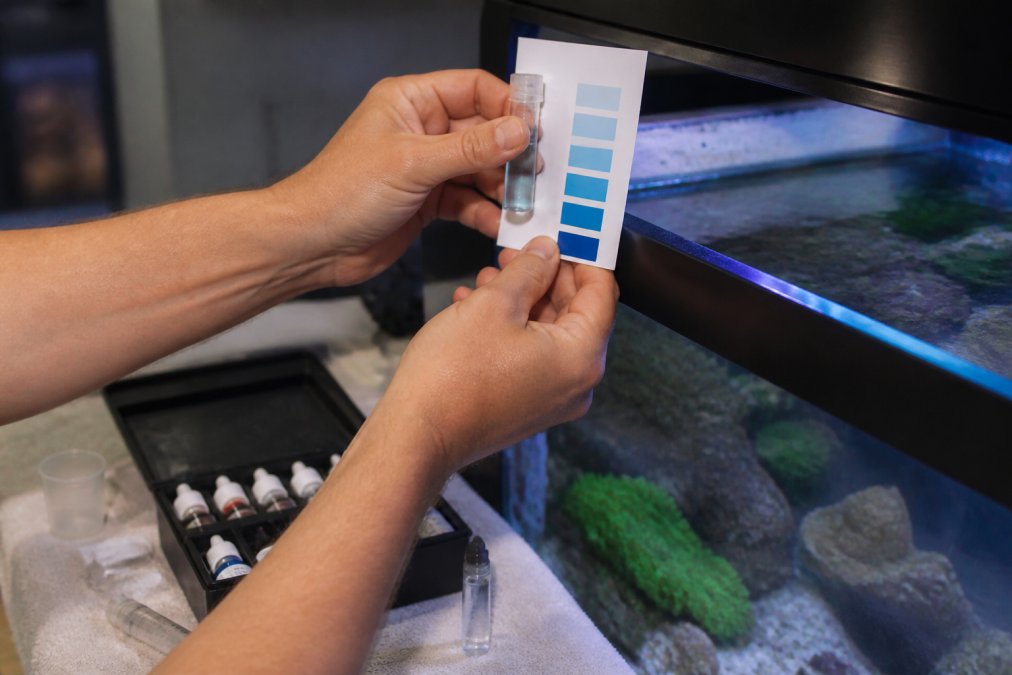
Testing your reef tank water correctly comes down to technique, and small mistakes produce misleading results. Follow this sequence for any manual kit or digital checker to get reliable readings every time.
- Wash and rinse your hands thoroughly. Residue from lotions or soaps contaminates samples.
- Rinse the test vial with tank water before collecting your sample. This removes any residue from the previous test.
- Collect your sample from a consistent location, ideally the display tank rather than the sump, away from direct dosing points.
- For colorimetric tests, zero the instrument with a clean sample before adding reagent. This step is critical for accuracy.
- Add the reagent, cap the vial, and gently swirl to mix. Avoid vigorous shaking, which introduces air bubbles that scatter light in digital readers.
- Wait the full reaction time specified by the manufacturer. Rushing this step is the most common source of error.
- Read the result immediately. Some reagents continue to react, so a delayed reading will be inaccurate.
Record every result in a logbook. A simple spreadsheet with date, alkalinity, calcium, magnesium, nitrate, phosphate, and pH columns lets you spot trends before they become problems. Many keepers find that a gradual downward drift in alkalinity signals that your dosing pump needs recalibration, long before coral health declines.
Digital vs. Analog Test Kits: Which Is More Accurate?
Digital colorimeters are more accurate than analog colorimetric kits, but only if you use them correctly. The primary advantage of digital readers is that they remove the subjective judgment involved in matching a colored liquid to a printed card. Two different people can look at the same analog test result and see different shades, which leads to inconsistent readings and unnecessary dosing adjustments.
Analog kits remain useful for parameters you test infrequently, like ammonia or iodine, where the cost of a digital reader is hard to justify. The tradeoff is precision. A digital checker like the Hanna line reads to a decimal point, while analog kits require you to estimate between color blocks. For alkalinity, calcium, and phosphate, where small changes trigger dosing decisions, the digital route is worth the extra cost. Many experienced keepers at Blue Earth Corals and Aquariums use digital checkers for daily parameters and keep a quality analog kit as a backup for emergencies.
When to Use ICP Water Testing Services
ICP water testing services analyze a small sample of your tank water in a laboratory, measuring dozens of elements including trace elements that standard kits cannot detect. ICP-OES, or inductively coupled plasma optical emission spectrometry, is the gold standard for identifying element depletion and contamination that slowly degrade coral health (peer-reviewed research).
Standard test kits cover the major parameters, but they completely miss trace elements like iodine, strontium, and vanadium, which play subtle roles in coral coloration and growth. ICP testing is the only practical way to measure these. Most hobbyists run an ICP test every three to six months, or any time they notice unexplained coral fading, poor polyp extension, or slow growth despite stable major parameters.
The drawback is cost and turnaround time. You ship a sample to a lab and wait days for results, which makes ICP testing a periodic diagnostic tool rather than a daily monitoring method. Use it to validate that your water change schedule and dosing regimen are keeping trace elements in balance, and to catch heavy metal contamination before it becomes visible damage.
Building Your Reef Tank Maintenance Schedule
A reef tank maintenance schedule should be built around your testing results, not the other way around. Testing frequency depends on the stability of your system and the sensitivity of your livestock. New tanks need daily checks for ammonia and nitrite during the cycle. Established mixed reefs can run on weekly testing for most parameters, with daily automated checks for alkalinity if you use a Trident.
The practical schedule that works for most hobbyists looks like this: test alkalinity, calcium, and magnesium twice per week if you are dosing manually, or trust the Trident if you have automation. Test nitrate and phosphate weekly, at the same time of day, to track nutrient export. Test pH and salinity weekly, and calibrate your refractometer monthly. Run an ICP test every three months.
Water changes are the backbone of trace element replenishment and nutrient export. A weekly water change of 10 percent of your system volume is a solid baseline for most tanks. If your ICP results show depleted trace elements, increase the frequency or volume temporarily. If nitrates and phosphates creep upward, the fix is usually more aggressive nutrient export, not larger water changes. Testing tells you which adjustment is needed.
The most successful reef keepers treat testing as a habit, not a chore. It takes five minutes twice a week to keep your finger on the pulse of your system, and those minutes save you from the heartbreak of losing expensive colonies to a preventable swing. Whether you rely on manual kits, digital checkers, or full automation, the discipline of regular testing is what separates thriving reefs from struggling ones.
Building a stable reef tank requires the right tools and the right guidance. At Blue Earth Corals and Aquariums, our team has 19+ years of experience helping hobbyists from their first tank to advanced SPS systems. We stock the full line of Hanna Checkers, Neptune Systems automation, and Red Sea aquarium systems, and our aquaculture facility in West Palm Beach grows healthy corals adapted to captive conditions. Whether you need help designing a system from scratch or want professional maintenance for an existing tank, we tailor solutions to your specific setup. Shop now to find the testing equipment your reef needs.
Frequently Asked Questions
How often should I test my reef tank water?
Test alkalinity, calcium, and magnesium weekly to keep them stable. Check salinity and pH the same day you do your water change. Test nitrate and phosphate every week or two, depending on your bioload. If you are dosing or adjusting parameters, test daily until things are consistent. Automated systems like the Neptune Systems Trident remove the guesswork and test alkalinity, calcium, and magnesium up to 24 times per day.
What is the difference between hobbyist test kits and ICP water testing services?
Hobbyist kits give you instant results for core parameters like pH, alkalinity, calcium, and nitrate using reagents and color matching. ICP water testing services involve mailing a water sample to a lab for a detailed analysis. ICP tests measure dozens of elements, including trace elements and potential toxins, which standard kits miss. Use a Hanna checker for quick weekly checks, and send off an ICP test every few months for a full health audit.
How do I interpret my reef tank water test results?
Compare your results to a reef tank water parameters chart. Aim for alkalinity between 8-12 dKH, calcium between 400-450 ppm, and magnesium around 1350-1450 ppm. Salinity should be 1.025 specific gravity (35 ppt). Nitrate should stay under 10 ppm, and phosphate under 0.05 ppm. The goal is stability. If a reading is off, make small adjustments and retest the next day rather than making large corrections.
Can I test my reef tank water without a kit?
You can check salinity with a refractometer and temperature with a thermometer, but you cannot measure critical chemical parameters like alkalinity, calcium, or nitrate without a test kit. Visual cues like algae growth or coral color can hint at problems, but they are not a substitute for actual data. Invest in reliable kits or a digital analyzer to avoid making decisions based on guesswork.
Buying Healthy Live Coral Online: A 2026 Buyer's Guide
Reef Tank Design Services: Custom Builds in Florida
Related Posts

How to Choose the Right Coral Lighting

SPS vs LPS Coral Care Requirements

Design a 75 Gallon Reef Tank: Complete Setup Guide

Coral Acclimation Guide for Hobbyists: 2026 Edition

Professional Reef Tank Installation Cost: 2026 Guide

How to Prevent Fish Disease Introduction: 7 Steps

Troubleshooting Common Reef Tank Problems: 2026 Guide
