

Best Equipment for Starting Saltwater Tanks
Table of Contents
- Essential Aquarium Tank Selection
- Filtration Systems and Protein Skimmers
- Lighting Requirements for Reef vs. Fish-Only
- Heaters, Temperature Control, and Powerheads
- Substrate, Live Rock, and Salt Mix Essentials
- How to Cycle a Saltwater Tank
- Saltwater Aquarium Maintenance Schedule and Automation
- Long-Term Operational Costs and Equipment Investment
- Frequently Asked Questions
Last Updated: September 4, 2026
The best equipment for starting saltwater tanks isn't the most expensive gear, it's pieces that work together to keep water stable. At Blue Earth Corals and Aquariums, we've spent over 19 years in West Palm Beach helping hobbyists move from freshwater to reef. The most common mistake is buying everything at once without understanding how each component supports the nitrogen cycle. This guide breaks down essential equipment, what to skip, and where money actually matters.
Essential Aquarium Tank Selection
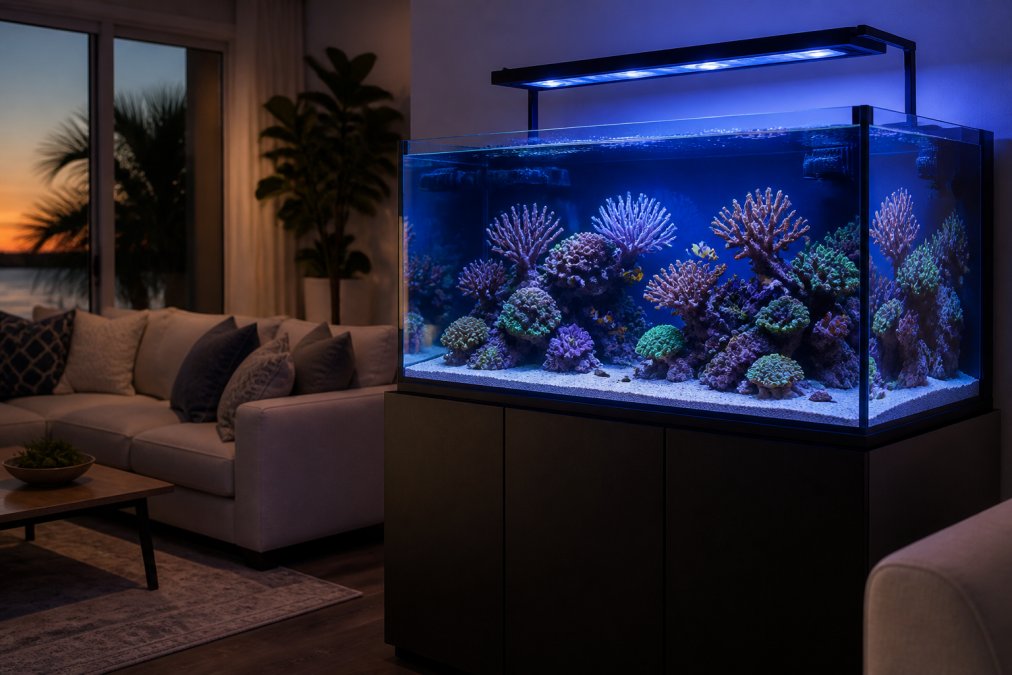
A 33-gallon system like the Red Sea REEFER Deluxe 170 G3 is the sweet spot for beginners: large enough to handle water chemistry swings, compact enough for a living room or office. Smaller tanks under 20 gallons fluctuate too quickly. All-in-one systems with built-in sumps simplify plumbing and hide equipment, making them the most forgiving option for your first saltwater setup.

Filtration Systems and Protein Skimmers
A protein skimmer is the single most important piece of equipment for a reef tank because it removes dissolved organic waste before it breaks down into nitrate and phosphate. Canister filters trap debris that decays in stagnant media; skimmers export waste continuously. For tanks up to 65 gallons, the Red Sea ReefMat 250 Fleece Roller Filter automates mechanical filtration. Biological filtration happens on live rock and substrate where beneficial bacteria process ammonia.

Lighting Requirements for Reef vs. Fish-Only
A fish-only tank needs only basic LED lighting. A reef tank with corals demands specific spectrum and intensity (PAR levels) to drive photosynthesis. The Red Sea ReefLED 115 G2 Light delivers 115 watts with Reef-Safe spectrum, acclimation mode, and cloud simulation. For SPS-dominant systems, look for fixtures with separate blue, white, and UV channels. LEDs have replaced metal halide and T5 because they run cooler, consume less power, and offer programmable cycles.
| Tank Type | Lighting Need | Recommended Approach | Budget Impact |
|---|---|---|---|
| Fish-Only | Basic visibility | Standard LED fixture | Minimal |
| Fish-Only with Live Rock | Moderate for coralline algae | Mid-range LED | Moderate |
| Soft Corals / LPS | Moderate PAR | Reef LED with blue channels | Moderate |
| Mixed Reef | High PAR, full spectrum | Programmable reef LED | Higher |
| SPS-Dominant | Very high PAR, uniform spread | Premium LED with UV channels | Highest |
Heaters, Temperature Control, and Powerheads
Temperature stability matters more than hitting a perfect number. Most reef tanks thrive between 76 and 80°F, and redundancy plus controller logic prevent catastrophic failures.
Heater Selection and Redundancy
A titanium heater like the AQUATOP 200W Titanium Heater resists corrosion; stainless steel corrodes in saltwater. Always pair with a digital thermometer and controller that shuts off if temperatures spike, a stuck thermostat can cook your tank overnight.
For tanks larger than 55 gallons, use two smaller heaters on separate controllers. A 75-gallon tank runs two 150-watt heaters instead of one 300-watt unit. If one fails, the second cannot overheat the tank past 84°F, eliminating single-point failure.
Controller Logic and Temperature Monitoring
A quality controller like the Neptune Systems A3 Apex Jr monitors temperature and triggers actions: powers heaters on below 75°F and off above 81°F. The hysteresis range prevents rapid cycling. Most controllers send phone alerts if the tank exceeds 82°F.
Water Movement and Flow Requirements
Corals need flow to deliver nutrients and remove waste. A gyre pump like the Red Sea ReefWave 25 creates broad wave patterns that mimic tidal surge, unlike traditional powerheads that create single jets.

Aim for 20 to 40 times your tank volume in gallons per hour of flow. A 33-gallon tank needs 660 to 1,320 gph. Underestimating flow creates stagnant areas where detritus settles and phosphate accumulates, fueling algae blooms.
Substrate, Live Rock, and Salt Mix Essentials
Substrate and live rock form the biological heart of your tank, hosting bacteria that complete the nitrogen cycle. The choice between new and used rock, and long-term substrate maintenance, directly impact your total cost of ownership and success rate.
Substrate Selection and Long-Term Maintenance
Aragonite sand buffers alkalinity and provides surface area for bacteria. A 33-gallon tank requires 40 to 50 pounds ($40-$80). Aragonite gradually dissolves over years, so most keepers replace 25-50% every two to three years to maintain alkalinity and remove detritus.
Over five years, expect $100-$200 in substrate replacement plus labor. Some keepers use a sand siphon during water changes to extend substrate life; others switch to bare-bottom tanks to eliminate maintenance, though this sacrifices biological filtration.
Live Rock: New vs. Used, and Curing Requirements
Aim for 1 to 1.5 pounds per gallon of live rock. A 33-gallon tank needs 33-50 pounds, costing $150-$400 depending on whether you buy new or used.
New live rock arrives fully cured and ready to add immediately. Used rock is cheaper but often requires curing, soaking in saltwater for one to two weeks while bacteria re-establish. During curing, ammonia and nitrite spike, requiring daily testing and water changes.
Used rock is safe if inspected carefully: look for solid structure, no dead spots or odors, and ask if recently exposed to air. Rock dry for more than a few hours requires longer curing. New rock costs more but eliminates curing and pest risk.
Salt Mix and Water Preparation
Always use RO/DI water rather than tap water to avoid phosphate, nitrate, and heavy metals that fuel algae. A basic RO/DI system costs $100-$200 and pays for itself within the first year.
The Red Sea Salt Improved Formula delivers 8 dKH alkalinity with balanced calcium and magnesium. Mix in a clean container with circulation, aerate 24 hours, and verify salinity (35 ppt or 1.026 specific gravity) with a refractometer, which is more accurate than a hydrometer.
Budget $30-$50 monthly for salt mix in a 33-gallon tank with biweekly 10-15% water changes. A 75-gallon tank requires $70-$100 monthly. This is one of the largest recurring expenses and should factor into your tank-size decision.
How to Cycle a Saltwater Tank
Cycling establishes the nitrification cycle that converts ammonia to nitrate. Set up your tank with live rock, substrate, and saltwater, then introduce an ammonia source (raw shrimp or bottled ammonia). Test every few days; ammonia and nitrite should spike then drop to zero while nitrate rises. The cycle is complete when 2 ppm ammonia reads zero within 24 hours. This takes four to six weeks; rushing it with fish causes ammonia spikes that kill livestock.
Saltwater Aquarium Maintenance Schedule and Automation
Consistent maintenance separates thriving reefs from chronic algae problems. Weekly: test alkalinity, calcium, magnesium; wipe glass; empty skimmer cup. Biweekly: 10-15% water change. Monthly: clean pump impellers, rinse media, trim algae. Automation (auto-top-off, dosing pump, controller) maintains consistency and sends phone alerts.
Long-Term Operational Costs and Equipment Investment
The real cost of a saltwater tank is not the initial setup, it's the monthly consumables and electricity that add up over years. Salt mix, replacement media, test kit reagents, and food represent a recurring expense that many beginners underestimate when comparing a 33-gallon system against a 75-gallon display. Larger tanks need more salt for water changes, more powerful lighting that draws more wattage, and bigger pumps that consume more electricity. A smaller reef tank like the REEFER 170 G3 reduces every one of these operational costs while still offering a satisfying coral display. When budgeting, plan for roughly 10 percent of your initial equipment cost annually in consumables and replacement parts. Consider buying used equipment to cut upfront costs, but inspect acrylic tanks for scratches, check that pumps run quietly, and never trust a used heater or controller with your livestock's life. The Marine Aquarium Societies of North America guidance on reef keeping costs emphasizes budgeting for ongoing testing supplies. A smart investment in automation, like the ReefATO+ and ReefMat, reduces the labor that causes most hobbyists to quit within the first two years.
The best equipment for starting saltwater tanks balances upfront investment against long-term stability, and a quality protein skimmer, reef-capable LED, and reliable heater form the non-negotiable core. Automation through auto-top-off, fleece filtration, and monitoring controllers transforms reef keeping from a daily chore into an enjoyable observation of a living ecosystem. Whether you are setting up your first 33-gallon system or expanding to a larger display, Blue Earth Corals and Aquariums offers the Red Sea REEFER Deluxe 170 G3, ReefMat 250, ReefWave 25, and ReefATO+ to build a cohesive system from day one. Our team designs complete setups from scratch and supports residential and commercial installations across South Florida. Reefkeeping guidelines from the American Veterinary Medical Association reinforce that stable water parameters prevent most livestock health issues. National Oceanic and Atmospheric Administration coral reef conservation resources offer background on why replicating natural reef conditions matters. Get started with Blue Earth Corals and Aquariums and build a reef system that thrives for years.
Frequently Asked Questions
What is the best saltwater tank setup for a beginner?
Start with a 30-40 gallon all-in-one or complete system like the Red Sea REEFER Deluxe 170 G3 that includes the tank, sump, and lighting. Beginners benefit from integrated filtration, built-in overflow boxes, and smart automation features. Include a protein skimmer, heater, powerhead, live rock, aragonite sand, and testing equipment. All-in-one systems reduce complexity and are more forgiving than custom builds.
What equipment do I need to start a marine tank?
Essential equipment includes: a tank with stand, sump or filtration chamber, protein skimmer, heater (200W for 30-55 gallons), powerhead or wavemaker, LED lighting, live rock and substrate, salt mix, refractometer or hydrometer for salinity testing, test kits for ammonia and nitrate, and an auto top-off system. Optional but recommended: aquarium controller for monitoring temperature and pH, dosing pumps for calcium and alkalinity, and a fleece filter for mechanical filtration.
How do I know if a protein skimmer is better than a canister filter for my saltwater tank?
Protein skimmers remove organic waste before it breaks down, making them superior for reef tanks with corals. Canister filters provide mechanical filtration but can trap detritus that fouls water quality. Most successful saltwater setups use both: a skimmer for biological prefiltering and a mechanical filter like the Red Sea ReefMat 250 for fine particle removal. Skimmers are essential for reef tanks; canister filters work better in fish-only systems.
How much does it cost to set up a saltwater aquarium?
A complete beginner setup costs $1,500-$3,000. A 33-gallon Red Sea REEFER Deluxe 170 G3 system runs $2,200 and includes the tank and lighting. Add a protein skimmer ($200-$400), heater ($100), powerhead ($350-$400), salt and testing equipment ($150-$300), and live rock and substrate ($200-$400). Larger tanks or advanced automation increase costs. Budget for ongoing maintenance supplies, salt mix, and replacement equipment.
What's the difference between used and new saltwater equipment?
New equipment comes with warranties, guaranteed functionality, and full manufacturer support. Used equipment is cheaper but may have hidden wear, missing parts, or failed seals that cause leaks. For critical items like heaters, powerheads, and controllers, new is safer, equipment failure can crash your tank overnight. Used tanks and stands are acceptable if inspected for cracks and leaks. Always verify used skimmers and filters function before purchase.
Best Saltwater Fish for Beginners in 2026
Buying Healthy Live Coral Online: A 2026 Buyer's Guide
Related Posts

How to Choose the Right Coral Lighting

SPS vs LPS Coral Care Requirements

Design a 75 Gallon Reef Tank: Complete Setup Guide

Coral Acclimation Guide for Hobbyists: 2026 Edition

Professional Reef Tank Installation Cost: 2026 Guide

How to Prevent Fish Disease Introduction: 7 Steps

Troubleshooting Common Reef Tank Problems: 2026 Guide
